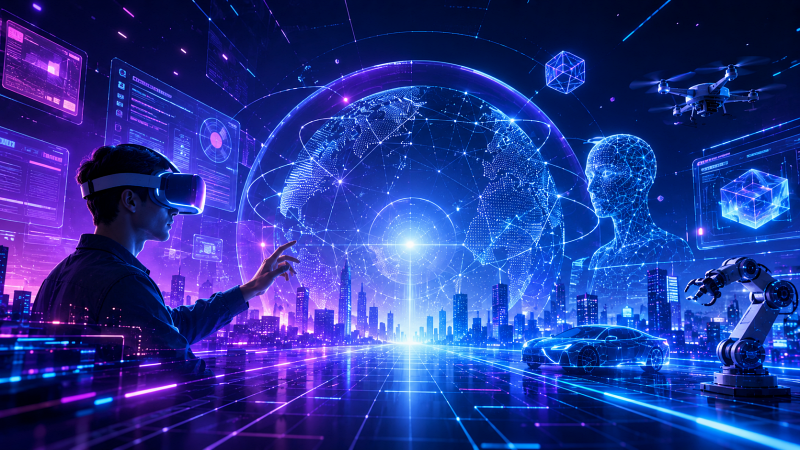
Metaverse provides immersive experiences in virtual worlds based on VR/AR fusion. AI enriches this space significantly. As AI technology rapidly advances, the fusion of metaverse and AI is revolutionarily changing the quality of sensory experiences. In early games, NPCs (Non-Player Characters) responded to simple commands; now AI-based NPCs autonomously learn and adapt, interacting naturally with users — evolving from simple characters to intelligent characters that evolve through user interaction. AI transformation of content creation: (1) AI tools like Copy.ai automatically generating writing and marketing content, enabling faster production; (2) Planning phase innovation — AI analyzing industry trends and user behavior to suggest optimal content strategies; (3) Content optimization — machine learning algorithms analyzing A/B testing results to optimize performance; (4) Personalization — AI adapting content based on individual user preferences and interaction history. Sensory experience evolution: haptic feedback AI systems learning user responses to provide appropriate tactile sensations; spatial audio AI creating 3D sound environments corresponding to virtual space; real-time emotion recognition adapting content to user emotional states; biometric feedback integration adjusting virtual environments based on physiological signals. AI-driven avatar personalization: generative AI creating unique avatars from minimal user input; real-time motion capture translation enabling natural avatar movement; facial expression AI creating emotionally expressive virtual faces. Future convergence: as AI, XR hardware, and connectivity improve simultaneously, the distinction between "immersive entertainment" and "functional virtual environment" will collapse — leading to metaverse applications in professional training, therapeutic interventions, and social connection that are indistinguishable in quality from physical experiences.
[Metaverse Meets AI ③] Personalized Interaction and Immersion — Sensory Experience Evolves
[Korean article] [메타버스와 AI의 만남③] 개인화된 상호작용과 몰입… 감각적 경험이 진화하다
![[Metaverse Meets AI ③] Personalized Interaction and Immersion — Sensory Experience Evolves](https://metax-images-bucket.s3.ap-southeast-2.amazonaws.com/articles/ai-1065607268751531/img-1.webp)
Source: META-X metax.kr
AI Bringing Changes to Interaction Methods in the Virtual World
ⓒ META-X metax.kr
All rights reserved.
Free to share with attribution.
All rights reserved.
Free to share with attribution.