User Backlash: "More Dangerous Than Safety is Biometric Data Collection"
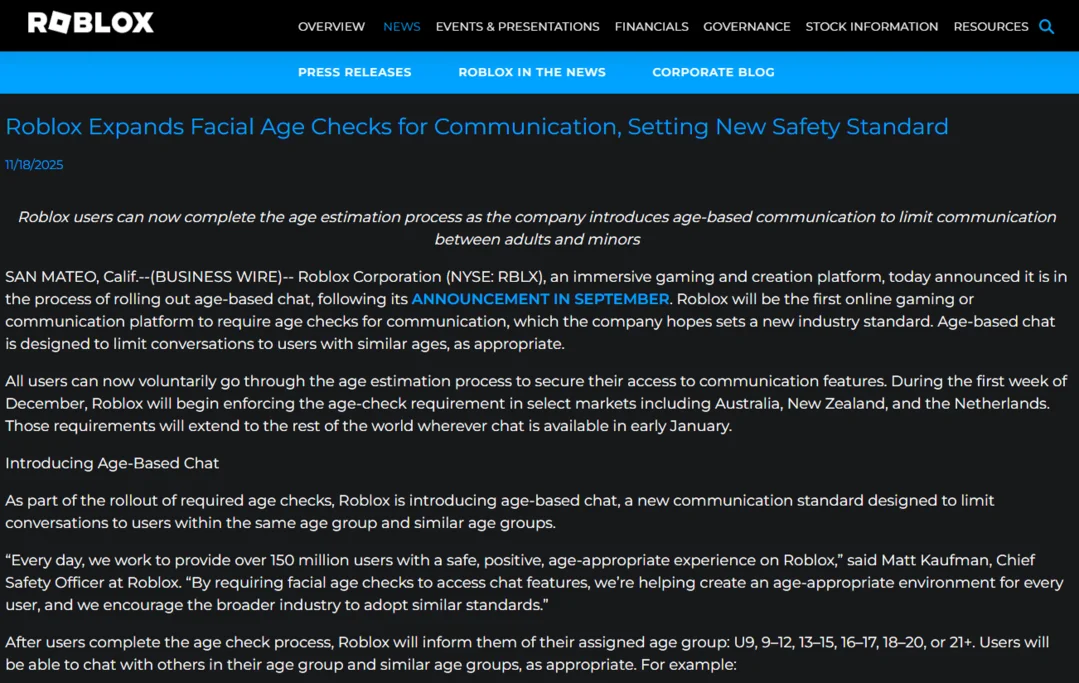
Roblox has been implementing facial recognition-based age verification (Facial Age Check) in select regions since early December, creating widespread platform controversy. The company started first-phase implementation in Australia, New Zealand, and the Netherlands, with plans for global expansion by January 2026. Key background: Roblox has 300M+ monthly active users, over half being children and teens. EU's Digital Services Act (DSA) and UK's Online Safety Act pressure platforms to implement stronger age verification. Birth date self-reporting proved unreliable. Facial age estimation technology is spreading across TikTok, Instagram, and other platforms as a new safety standard. User backlash centers on the face video submission method itself — Roblox's age estimation partner Yoti processed facial scans locally (not stored on Roblox servers), but questions about third-party data security and the precedent of biometric collection remain. Secondary controversies: chat function restrictions for users not completing verification; scanner malfunctions affecting legitimate users; processing uncertainty for edge cases. Privacy experts note that facial biometric data carries unique risks — unlike passwords, biometric data cannot be "reset" if compromised. The broader debate: platform safety requirements increasingly conflict with privacy rights, particularly when the population being "protected" includes children whose parents' consent may be required for biometric data collection but is not clearly being obtained in all jurisdictions.