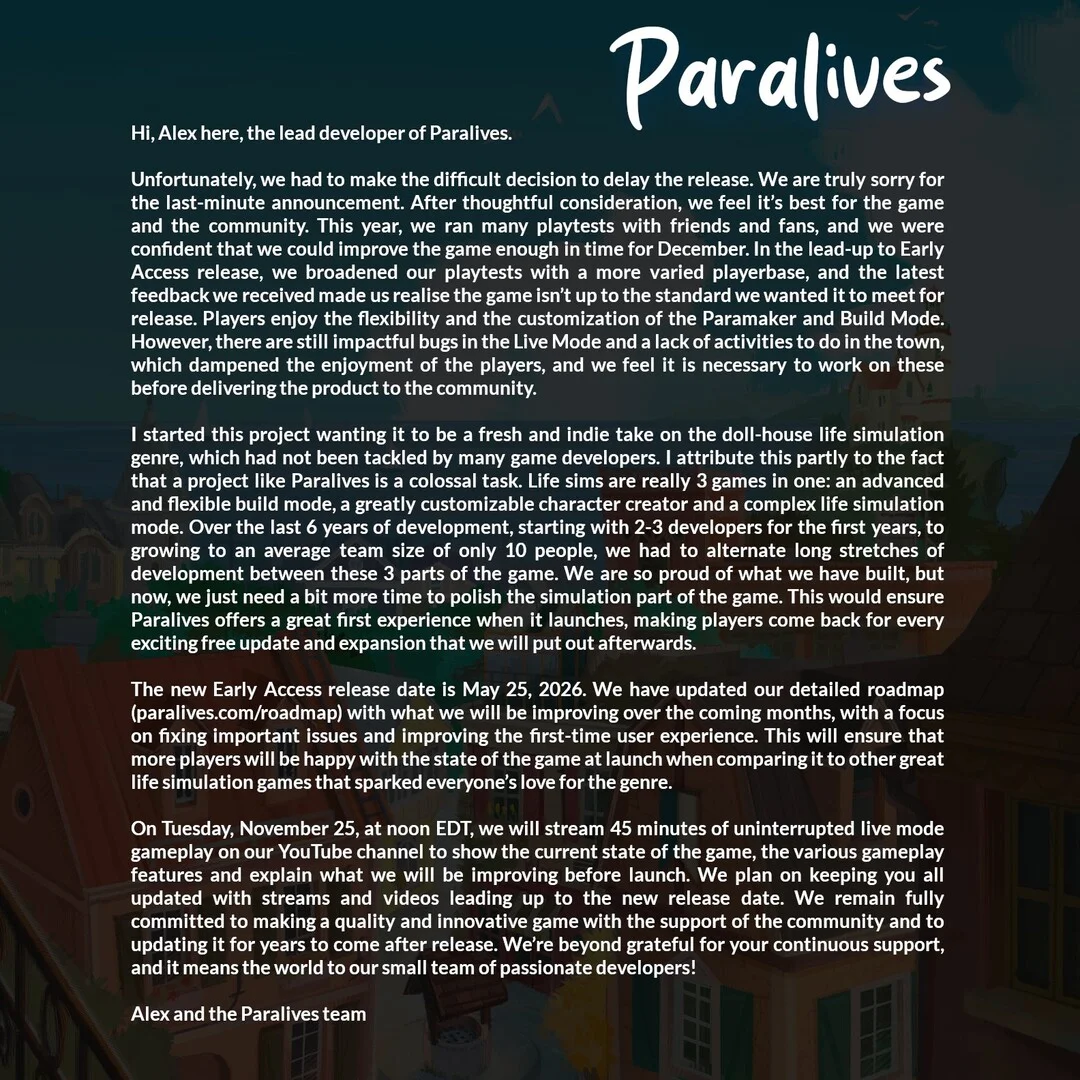
Life simulation game "Paralives," considered one of the indie ecosystem's most anticipated projects, is delaying its release to May 25, 2026. Lead developer Alex stated in a lengthy public message: "The game's core mode has not yet met our standards" and "more time is needed to provide players with a proper experience." Six years of small-scale development and unpredictable playtesting results ultimately led to the delay.
The development team explained that expanded playtesting revealed more problems than expected. Key issues include: frequent bugs in Live Mode, insufficient activities in the town making the "life simulation" experience lacking, and player experience (UX) quality not meeting target levels. The team determined this requires "structural adjustments to meet the release standard itself, not just simple feature repairs."
Alex also disclosed honest technical background on why Paralives development has been prolonged: "Life simulation games are essentially the same as making three games simultaneously" — an advanced build mode, a high-freedom character customization system (Paramaker), and a life simulation mode where daily life, emotions, relationships, time, and economy interact. AAA game studios deploy hundreds of people for areas Paralives handles with an average team of around 10.
Along with the delay announcement, the team released a new roadmap prioritizing First-Time User Experience improvement, significant Live Mode bug reduction, enhanced town interaction elements, and "functional stabilization" over content addition. A 45-minute live gameplay broadcast was also announced for November 25, 2025, demonstrating the team's philosophy of prioritizing community communication.
Paralives has been evaluated as the strongest indie rival in the life simulation genre almost monopolized by The Sims series. As The Sims 4 faced criticism for years of repeated DLC policies and post-free-to-play content structure, Paralives attracted even greater expectations. The delay is disappointing, but community reaction has been largely positive given the team's emphasis that "rather than releasing now, this is a choice for making a game loved for a long time." Paralives' delay is not simply a schedule change — it is an extension of the experiment of "how an indie team completes a high-difficulty simulation genre," and simultaneously a challenge opening the future of the genre.