[MetaX] The conventional formula of marketing has long followed a familiar logic: an information source, usually an expert, explains a product’s superior quality and functional value in a rational manner; this builds brand trust, which then naturally leads to purchase. However, the study by Baek Jong-woo and Jang Seok-jun (2025) argues that this classical mechanism no longer works for the MZ generation, the core consumer group in the mobile media environment.
This study empirically analyzed survey data from 492 MZ-generation consumers who recognized the value of luxury goods through the influence of social media influencers and had completed an actual purchase. The data were analyzed using structural equation modeling (SEM). Of the respondents, 73% were women, and the main age groups were consumers in their 30s (65.4%) and 20s (29.1%).
A Study on the Effect of Influencer Characteristics on Luxury Brand Consumption: Focusing on the MZ Generation Baek Jong-woo, Jang Seok-jun, 2025 |
Why Influencer “Expertise” Has Lost Its Power
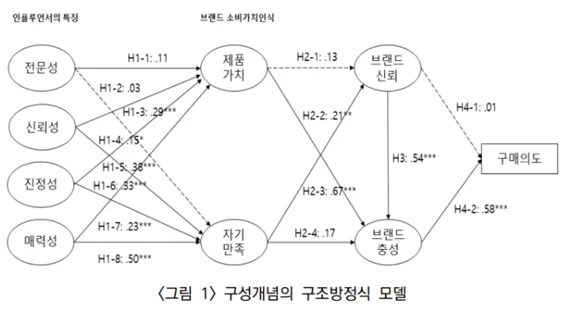
The hypothesis that influencer expertise would have a positive effect on the self-satisfaction of the MZ generation was rejected.
The transmission of extensive product knowledge by influencers may contribute, albeit only slightly, to the MZ generation’s perception of functional product value (beta = .113), but it has no effect on the emotional domain of self-satisfaction. This appears to be connected to the fact that the MZ generation consists of “digital natives” who have used digital devices from birth. They already possess the ability to collect, compare, and analyze expert-level information on their own through various mobile platforms. In other words, they do not expect influencers to serve as providers of knowledge or as sources of informational dependence.
By contrast, the emotional characteristics of influencers produced an entirely different result.
Attractiveness (beta = .500), authenticity (beta = .334), and trustworthiness (beta = .149) all had a strong positive effect on self-satisfaction. In particular, attractiveness, referring to the refined image or style of an influencer, emerged as the most dominant factor in forming self-satisfaction. The MZ generation is not trying to learn expert knowledge from influencers. Rather, they project themselves onto the influencers’ lifestyles and attractiveness, gaining emotional pleasure and satisfaction in the process.
The Broken Link Between Product Value and Brand Trust
What is particularly interesting is that self-satisfaction proved to be more decisive than product value.
Contrary to general consumer theory, the study found that the MZ generation’s evaluation of luxury goods in terms of quality, collectible value, and uniqueness — that is, product value — is separate from their psychological trust in the brand. These consumers take the high quality of luxury goods as a given. The mere fact that a product has excellent specifications does not automatically lead them to feel intimacy with or trust toward the brand.
Instead, the key driver of brand trust was found to be self-satisfaction (beta = .671). Only when consumers experience subjective post-purchase rewards such as pleasure, satisfaction, and confidence from consuming a luxury brand does firm trust in that brand begin to form. In other words, the psychological reward felt by the consumer is a more central variable in building brand relationships than the objective excellence of the product itself.
What Drives Purchase Is Loyalty, Not Trust
Another notable finding is that brand trust did not have a direct effect on purchase intention. The path from brand trust to purchase intention was rejected, with a standardized coefficient of .005. By contrast, the path from brand loyalty to purchase intention was statistically significant, with a standardized coefficient of .582. Brand trust strongly affects brand loyalty, but it does not directly lead to purchase intention. In other words, trust is not the immediate purchase button. It is closer to the foundation on which loyalty is built.
This result is also closely connected to the characteristics of luxury consumption. Luxury goods are not products that consumers buy immediately just because they feel the brand is trustworthy. They are expensive, highly symbolic, and strongly reflect personal taste and identity. For that reason, purchase intention emerges more powerfully at the stage of loyalty than at the stage of trust. Consumers develop stronger purchase intentions when they form an emotional attachment: when they want to keep choosing the brand, incorporate it into their own system of taste, and buy it again in the future.
In this sense, what luxury brands need to do is not secure one-time trust, but form repeated emotional relationships. Beyond sending the message that the brand is safe and of high quality, brands must lead consumers to accept the brand as “a world I like.” The same applies to influencer marketing. Campaigns designed to create repeated emotional experiences with a brand are likely to be more effective than campaigns that simply deliver accurate product information.
The Core of Influencer Marketing Is an “Emotional Persuasion Structure”
In MZ-generation luxury consumption, influencers are less like experts who convey product knowledge and more like figures who construct the emotional value of luxury goods through trustworthiness, authenticity, and attractiveness. The study also suggests that luxury brand companies should focus more on emotional characteristics such as trustworthiness, authenticity, and attractiveness when designing influencer marketing strategies, rather than emphasizing the delivery of knowledge about products and services.
What matters here is that “emotional characteristics” do not merely refer to superficial image management. Trustworthiness is the sense that the brand introduced by this person is reliable. Authenticity is the perception that the recommendation comes not from advertising copy, but from the influencer’s actual taste and experience. Attractiveness is not simply a matter of appearance. It refers to the extent to which the influencer’s style, attitude, lifestyle, and atmosphere stimulate the consumer’s desire. In luxury consumption, these three elements operate in a more complex way than product function.
Put differently, influencer marketing for luxury goods aimed at the MZ generation is not a process of persuading consumers that “this product is good.” It is a process of making them imagine “what kind of person I become when I choose this product.” Consumers do not use influencers merely to check product specifications. Instead, they pre-experience the possible self-image in which the product may be placed. This is precisely why luxury brands use influencers. Influencers act as mediators who translate the meaning of a brand into scenes of everyday life.
[METAX = Reporter Ryu Sung-hoon]