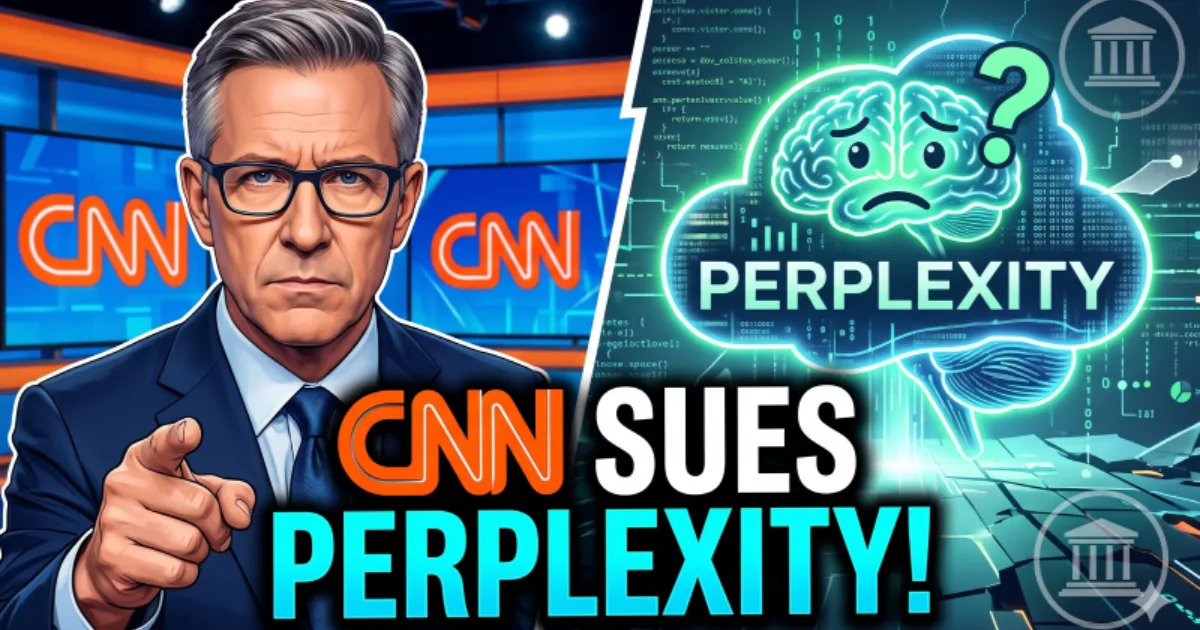
CNN has filed a copyright and trademark lawsuit against AI search company Perplexity, placing the fast-growing “answer engine” model at the center of the escalating legal battle between artificial intelligence companies and news publishers.
According to a complaint filed on May 28, 2026, in the U.S. District Court for the Southern District of New York, CNN alleges that Perplexity copied and used more than 17,000 CNN works, including articles, videos and images, without authorization to operate its generative AI products.
CNN argues that Perplexity’s conduct goes beyond ordinary search or link aggregation. The company claims that Perplexity repackages CNN’s journalism into AI-generated answers, reducing the need for users to visit CNN’s original websites.
The lawsuit marks a new phase in the conflict between AI and media copyright. Until now, many generative AI copyright disputes have focused on the use of large-scale training data. CNN’s complaint goes further by challenging how real-time AI search and retrieval-augmented generation, or RAG, collect news content and redistribute it as answers.
At the center of the case are two stages. First, CNN claims that Perplexity crawled, scraped and copied CNN content from CNN’s digital platforms and third-party sources for use in its AI search indexes and RAG systems. Second, CNN alleges that Perplexity’s chatbot, browser and APIs generated answers that were identical or substantially similar to CNN articles. CNN argues that both stages constitute copyright infringement.
CNN’s Claim: Perplexity Is Not Search, but a Substitute
In its complaint, CNN describes Perplexity as an “answer engine.” Unlike a traditional search engine, which displays multiple links and sends users to original websites, CNN argues that Perplexity provides synthesized answers that allow users to avoid clicking through to source material.
CNN also points to Perplexity’s past use of the phrase “Skip the links” as evidence that the company marketed an experience built around bypassing source websites.
This distinction is central to the copyright debate. Traditional search engines typically provide indexing and short snippets in exchange for sending traffic to original publishers. AI answer engines, by contrast, may reduce the path back to the original source and encourage users to consume information within the AI platform itself.
CNN claims that this structure directly harms publishers’ digital advertising, subscription and licensing revenue.
The complaint also argues that Perplexity uses CNN content not only in free services, but also in paid subscription plans, enterprise offerings and API products. CNN cites Perplexity Pro, Enterprise Pro and Enterprise Max, along with features such as deeper source access, search across the web, team files and work apps, and large-scale deep research.
From CNN’s perspective, this means Perplexity is converting costly journalism produced by news organizations into value for its own commercial products.
Why RAG Is at the Center of the Case
A key technical concept in the lawsuit is RAG, or retrieval-augmented generation. RAG refers to a method in which a large language model retrieves relevant external documents or webpages before generating an answer. Unlike a general LLM that relies mostly on knowledge encoded during training, RAG can pull in current information and specific sources to produce more timely and grounded responses.
The legal question is where that reliability comes from.
CNN argues that Perplexity’s RAG system depends on high-quality reporting from publishers such as CNN. In other words, Perplexity can provide accurate answers because CNN journalists conduct reporting, editors verify information, and the news organization spends money to produce the underlying content.
CNN criticizes Perplexity for using its reporting as RAG material without operating its own comparable newsroom of reporters, editors and newsgathering infrastructure. From this perspective, AI search can become a substitute for journalism without bearing the cost of producing journalism.
That is the fundamental concern news publishers are raising against AI search companies.
Robots.txt and Allegations of “Stealth Crawling”
CNN also challenges how Perplexity allegedly accessed CNN content. According to the complaint, CNN had blocked PerplexityBot and says Perplexity knew it had no right to use CNN content. Despite this, CNN alleges that Perplexity collected or used CNN content through software programs such as PerplexityBot and Perplexity-User, or through third-party indexes and databases.
CNN also cites external reporting that Perplexity ignored or bypassed technical access restrictions such as robots.txt. Robots.txt is a standard mechanism that allows website operators to communicate which areas of a site crawlers may or may not access.
CNN claims that Perplexity-User generally ignores robots.txt rules and that investigations found possible attempts to avoid blocks through undisclosed IP addresses or unidentified user agents.
This part of the lawsuit raises a broader question of technical trust between AI companies and content owners. If AI services use web content, must they respect access restrictions set by site operators? Does robots.txt carry legal force? Is accessing content without clearly identifying the crawler a technical circumvention?
The CNN lawsuit brings these questions directly into court.
The Output Question: Summary or Substitute Copy?
CNN argues that Perplexity’s outputs go beyond ordinary summaries. The complaint includes examples involving Perplexity’s chatbot, Comet browser, Search API and Agent API, alleging that they reproduced parts or even substantial portions of CNN articles.
CNN says these responses exceed the limited snippets typically associated with search results and instead provide substitute outputs that make reading the original article unnecessary.
In one example, CNN alleges that Perplexity Pro nearly reproduced portions of a CNN article when asked to analyze it. In another, CNN claims that Perplexity’s Search API output substantial parts of a CNN article when only part of the article’s headline was entered. CNN also makes a stronger allegation involving the Comet browser, claiming that Comet Assistant provided article content from behind CNN’s paid subscription wall to a non-subscriber.
This claim highlights the central risk of AI search. If an AI answer provides only brief factual information and directs users to sources, it may function as a search assistant. But if it provides the full text or substantial portions of a paid article, it may replace the market for the original work.
CNN argues that this replacement effect harms its subscription, advertising and licensing businesses.
Trademark Claims: CNN Says AI Hallucinations Damage Its Brand
The lawsuit is not limited to copyright. CNN also alleges trademark infringement, false designation of origin and trademark dilution. CNN claims that Perplexity used CNN marks without authorization, falsely suggested an affiliation with CNN, and presented hallucinated or altered content as if it came from CNN.
According to the complaint, CNN and Perplexity agreed in October 2025 to a term sheet related to Comet Plus, but the agreement did not result in a final contract, and the parties terminated the term sheet on November 24, 2025. CNN claims that after that point, Perplexity continued to imply that it could access CNN premium content.
CNN views this as conduct that could falsely suggest a partnership that no longer existed or never fully materialized.
CNN also alleges that Perplexity associated inaccurate or fabricated statements with CNN content. If an AI system presents a hallucinated answer alongside CNN’s name, users may blame the error on CNN rather than the AI platform. For CNN, this is not merely an information error. It is a potential injury to brand trust.
CNN Seeks Damages and a Permanent Injunction
CNN brings claims for copyright infringement, contributory and vicarious copyright infringement, false designation of origin, trademark dilution and trademark infringement. The company has requested a jury trial.
CNN is seeking statutory damages, actual damages, treble damages, disgorgement of profits, attorneys’ fees, litigation costs and a permanent injunction against Perplexity’s allegedly unlawful conduct.
The important point is that CNN is not only seeking compensation for past alleged infringement. It is also trying to stop the structural way in which Perplexity allegedly collects news content and redistributes it as AI answers.
The case may therefore help determine how far courts will allow AI search services to go in using news content for retrieval and generated responses.
Why Perplexity Became a Target
Perplexity occupies a critical position between traditional search and generative AI. While companies such as OpenAI and Anthropic are often seen primarily as general chatbot or model companies, Perplexity has built its identity around AI search and the answer engine model.
Its core value proposition is simple: users ask a question, Perplexity searches the web in real time, attaches sources and provides a summarized answer.
That model is convenient for users. But for publishers, it can be threatening. Even when Perplexity provides source links, users may not click them if the AI-generated answer is detailed enough. Source citations may increase trust in the answer without generating traffic for the original publisher.
CNN argues that this structure transfers economic value from news producers to AI platforms.
The complaint also notes that Perplexity has faced legal challenges involving other media and information companies, including Dow Jones, the New York Post, The New York Times, the Chicago Tribune, Encyclopaedia Britannica and Merriam-Webster. This suggests that Perplexity is becoming a legal test case for AI search.
The Media Industry’s Larger Concern: The Traffic-Based Internet Is Shaking
The broader significance of the lawsuit lies in the changing structure of internet news distribution. For more than two decades, publishers have relied on search engines, social media and portals to generate traffic and convert that traffic into advertising or subscription revenue.
That system created its own platform dependency problems. But at least search results and social links generally directed users back to original websites.
AI answer engines work differently. A user asks a question, the platform summarizes the answer, displays sources and keeps the user within the platform. In this structure, the original producer may become less visible, or visible but unclicked.
For publishers, this is not discovery. It is substitution.
CNN cites research suggesting that AI bots send far less referral traffic than traditional Google search. Whether that claim will carry legal weight remains to be seen, but the crisis felt by publishers is clear. As AI search spreads, visits to original sites, advertising impressions and subscription conversions may decline.
Perplexity’s Likely Defense: Fair Use and Search Innovation
Perplexity is likely to argue that AI search is a transformative use designed to answer user questions, provide citations, improve access to information and evolve traditional search. It may also argue that RAG is not intended to store or replace entire works, but to improve answer accuracy using current information.
Fair use is likely to become a central issue. Courts typically examine the purpose and character of the use, the nature of the copyrighted work, the amount and substantiality of the portion used, and the effect on the market for the original work.
CNN argues that Perplexity commercially copied CNN content at scale, reproduced substantial portions, and harmed CNN’s subscription, advertising and licensing markets. Perplexity, by contrast, may argue that search and summarization improve public access to information, provide source attribution and serve an informational function.
The difficult issue is that CNN’s complaint includes allegations of full or substantial reproduction, not merely brief summaries. If a court finds that Perplexity’s outputs substitute for the original market, the current operating model of AI search services could face major constraints.
Why This Matters Beyond the United States
Although this lawsuit was filed in the United States, its implications extend far beyond the American media market. In countries such as South Korea, portals, search engines, social platforms and generative AI services are already reshaping news distribution. If AI search services begin summarizing and answering questions based on Korean-language news in real time, publishers could face greater pressure on original traffic and subscription conversion.
This risk may be particularly acute in markets where news organizations depend heavily on portals and have not yet built strong direct subscription models. If AI answer engines provide article summaries directly, publishers may bear the cost of producing journalism while platforms capture much of the value.
News organizations may therefore need to prepare in three ways.
First, they will need clearer terms of use and technical policies governing AI crawling and RAG use. Second, licensing agreements with AI companies will need to specify use cases, output limits, attribution rules, revenue sharing and responsibility for hallucinations. Third, publishers will need to strengthen forms of journalism that are harder to replace, including field reporting, investigative reporting, data journalism and reader communities.
Conclusion: The Future of AI Search Depends on Who Pays for the Answer
CNN’s lawsuit against Perplexity directly raises the central question of the AI search era. Users want fast and convenient answers. AI companies meet that demand by searching and summarizing news content. But the organizations that send reporters into the field, take risks, verify facts and pay the cost of editorial production are the news publishers.
AI search is changing how people access information. But if that innovation weakens the economic foundation of information production, the quality of AI-generated answers may also decline over time.
AI does not go to the scene of a war. It does not report from a disaster zone. It does not verify facts on the ground or interview people in power. For AI to answer, someone must first record the facts.
The CNN-Perplexity case is therefore not just a dispute between one news organization and one AI company. It is an industrial conflict over who should bear the cost of high-quality information in the generative AI era.
The court’s view of what counts as fair use, and what crosses the line into unauthorized substitution, could shape the future of both AI search and digital journalism.
The age of skipping links has arrived. Now the courts must decide how to value the labor, cost, rights and responsibilities behind the links being skipped.