New Front Where Digital Censorship, Child Protection, and Freedom of Expression Collide
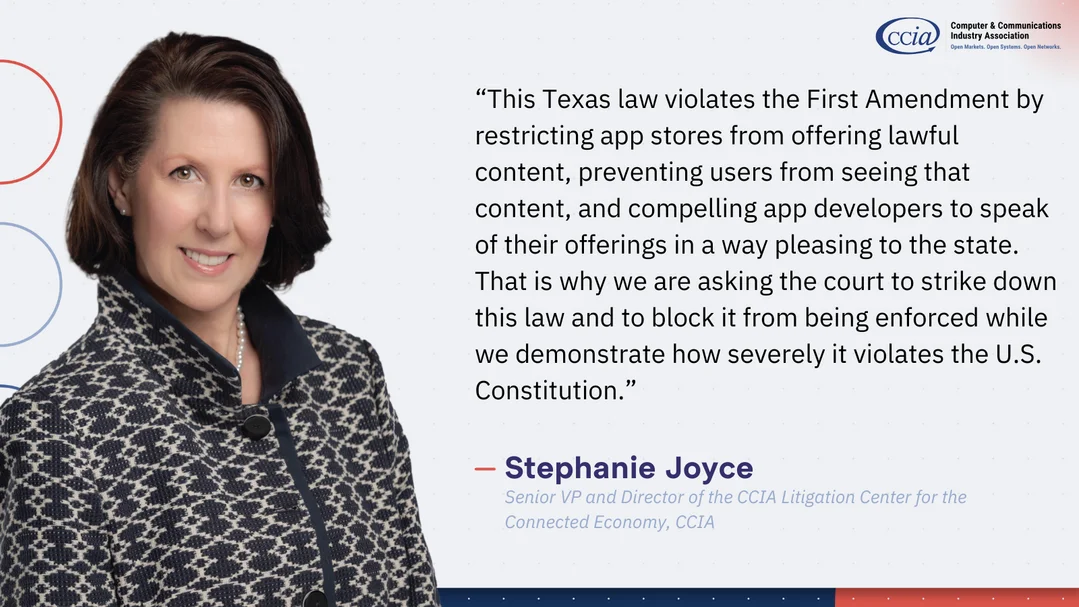
The Computer & Communications Industry Association (CCIA) filed a constitutional challenge against Texas's mobile app store regulation law (SB2420). The law, scheduled to take effect January 1, 2026, mandates age verification, parental consent, and content classification for all app stores and developers. CCIA called it "an unconstitutional measure that violates freedom of expression, infringes privacy, and places excessive burdens on businesses and individuals."
SB2420's core provisions: (1) Mandatory age verification for all users including app downloaders; (2) Prohibiting minors from most app downloads and in-app purchases without explicit parental consent; (3) Requiring all apps to self-report detailed age ratings and report changes to app stores and government. While superficially youth protection, actual application could infringe on freedom of expression and operational autonomy of the entire app ecosystem.
Constitutional issues: (1) Compelled speech — requiring developers to describe apps "per state-defined age rating criteria" constitutes compelled speech (Wooley v. Maynard, 1977); (2) Prior restraint — pre-blocking minor access may constitute constitutionally prohibited prior restraint; (3) Privacy infringement — mandating all user identity verification potentially violates privacy rights (Griswold v. Connecticut, 1965). The law's core is not "child protection" but "the attempt for the state to control the language and structure of digital platforms."
Texas has been at the forefront of legal clashes with online platforms in recent years: 2021 HB20 (limiting social media content deletion, currently before the Supreme Court), 2023 TikTok ban on government devices, and now 2025 SB2420. If implemented, major platforms may need Texas-specific app policies — raising operating costs, restricting content access, violating user privacy, and increasing developer administrative burdens. CCIA's lawsuit is not a simple legal dispute but "a new constitutional test in the age of AI, data, and app ecosystems" — the question of where digital protection becomes censorship.