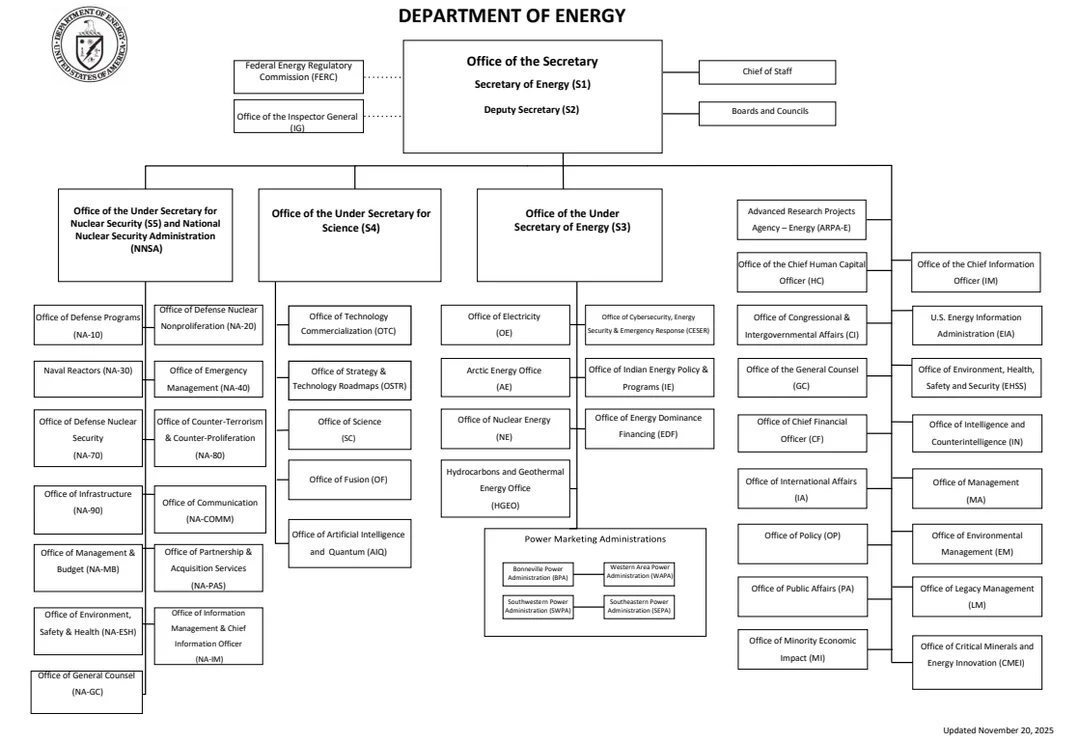
Structural Reorganization for US Energy Production Expansion, Nuclear Weapons Management Strengthening, and Science/Technology Competitiveness Enhancement
The US Department of Energy (DOE) officially announced a comprehensive organizational restructuring on November 20 (local time) to implement President Trump's "American Energy Dominance" strategy. The restructuring reflects the administration's policy priorities centered on energy production expansion, technology leadership strengthening, and nuclear weapons management system advancement — showing that US energy policy is transitioning back to a "supply-centered, industry-centered" strategy.
DOE stated in its official announcement that the organizational restructuring is "a measure to maximize the efficiency necessary for accelerating science and technology innovation, strengthening nuclear security frameworks, and expanding domestic energy production." Energy Secretary Chris Wright said the organization was restructured "to restore common sense to energy policy overall under the President's leadership, lower costs for American households and businesses, and strengthen accountability in tax use."
The restructuring supports three government objectives: (1) Strengthening interdepartmental cooperation frameworks for expanding domestic fossil and nuclear energy production; (2) Function adjustment and efficiency improvement of R&D organizations dedicated to energy technology and science research; (3) Internal structural reorganization for securing safety of nuclear weapons management and national security-related facilities.
Politically, economically, and technologically, this restructuring symbolizes America returning its direction from "energy independence" to "Energy Dominance" — continuing from Trump's first administration with expanded shale oil/gas production, increased LNG exports, and coal/oil industry deregulation. This announcement is expected to have considerable ripple effects in global energy markets: expanded US energy production and export-centered policies could lead to increased international oil price volatility, European/Asian LNG supply adjustments, coal/nuclear policy readjustments, and renewable energy investment flow changes. The mention of strengthening nuclear weapons asset safety and readiness signals the US is comprehensively coordinating national security, energy security, and technology hegemony strategies in the context of strategic weapons competition with China and Russia.