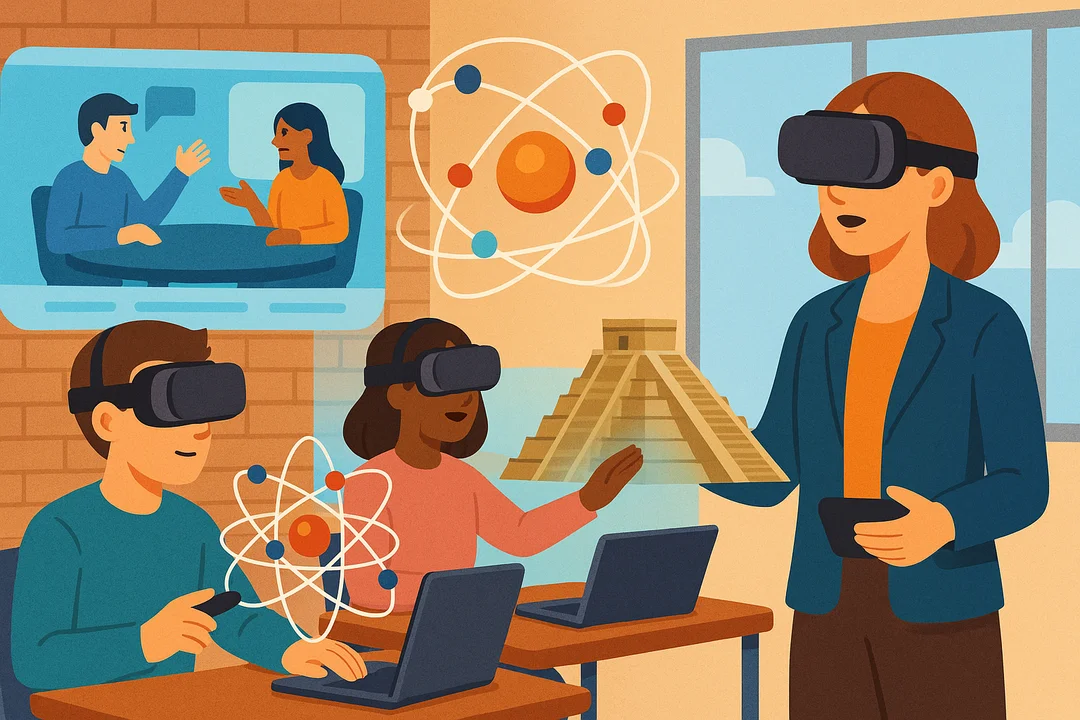
From digital classrooms to virtual reality labs, new spaces where students and teachers meet are opening. Metaverse is not just technology — it is changing the "stage" of education. The term "metaverse" combines "meta" (transcendence) and "universe," meaning a virtual digital space beyond the real world. Initially attracting attention in gaming and entertainment, it is now expanding into education, healthcare, business, and public administration. Education's interest in the metaverse is clear: it enables learner-centered learning experiences in immersive environments without physical constraints. Post-COVID-19, the education community is seeking new learning models beyond one-way lecture-style classes through the metaverse.
Three main ways metaverse is currently applied in education: (1) Immersive learning spaces — VRWARE's "Chemistry Lab VR Content" enables safe virtual experiments in school environments where actual chemical reactions are difficult; students wear goggles and learn element and molecular reactions in immersive experimental environments; used in science, engineering, and arts for hands-on education; (2) Historical and cultural experience content — Google Arts & Culture and Seoul's "Virtual Seoul 600-Year Street" project enable students to explore 3D-restored cultural heritage; examples include walking through Gyeongbokgung Palace to understand its structure, or exploring Maya civilization via VR; evolving from text-based learning to "immersive learning" including visual, spatial, and emotional experiences; (3) Global collaboration spaces — Meta's Horizon Workrooms enables users worldwide to connect to virtual meeting rooms for project-based learning and international exchanges. Implications: metaverse education removes geographic barriers, enables experiential learning impossible in physical classrooms, and supports both synchronous and asynchronous collaboration — potentially addressing equity gaps by giving all students access to facilities (labs, historical sites, museums) previously accessible only to the privileged.