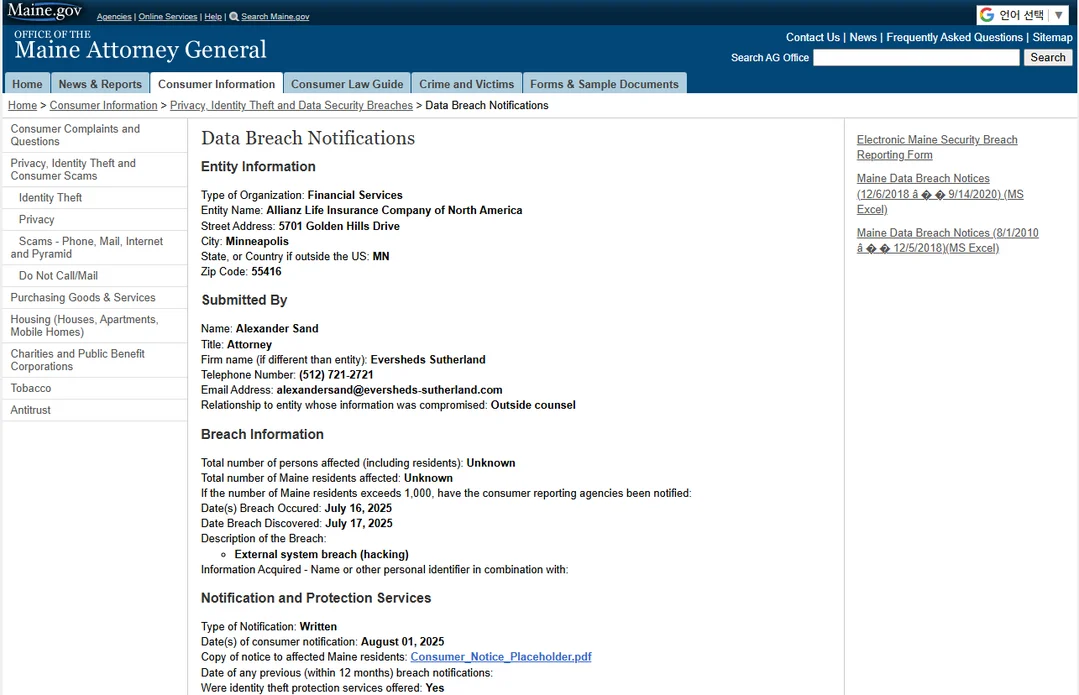
Allianz Life Insurance Company of North America officially reported a system breach through external hacking on July 16, 2025, with personal identifying information (PII) leaked. This is significant for occurring at an institution handling sensitive personal information, with the damage scope still being assessed.
According to the data breach report submitted to Maine''s Consumer Protection Bureau by Allianz''s legal representative Alexander Sand (Eversheds Sutherland), the breach occurred through an external hacking attack on July 16, 2025. Allianz detected abnormal access traces in their systems the following day, July 17, and began official victim notification procedures on August 1, 2025. Currently 1,000+ individuals (including Maine residents) are potentially affected, with separate notification to credit agencies. Three possible causes: (1) Third-party vendor-mediated intrusion possibility — Allianz''s vast customer information linked with external commissioned systems; (2) Credential theft rather than direct attack — hackers may have obtained internal user credentials through phishing; (3) Cloud backup vulnerabilities — recently adopted cloud-based data preservation policies may have served as a vulnerability.
Allianz is providing 24 months of free "identity theft prevention and credit monitoring services" to affected users through global risk management specialist Kroll: real-time credit information monitoring, identity theft detection and recovery support, and legal consultation. However, since leaked information includes names and other PII, mere credit monitoring is insufficient for the seriousness of this breach — psychological anxiety and distrust are difficult to fully resolve with after-the-fact measures alone. The key lesson: "Trust begins not from ''initial response'' but from ''advance design.'' Going forward, preventing hacking from occurring in the first place will be the first step in trust recovery." The financial sector''s structural risk of credit bureaus and insurers becoming prime hacking targets requires more sophisticated technical, management, and oversight systems between cloud providers, public institutions, and regulatory bodies.