![[Paper Review] Can AI-Generated Advertising Really Beat Traditional Ads?](https://metax-images-bucket.s3.ap-southeast-2.amazonaws.com/defaults/research1.webp)
Traditional Ads Worked More Powerfully for Consumers with High Brand Attitude
Since generative AI entered the advertising production field, the most common refrain has been "Now we can make ads much faster and cheaper." Indeed, the scope of AI involvement — from images and copy to video storyboards, music, and narration — is rapidly expanding. But this paper immediately throws cold water on that optimism. The core question is simple: Can ads made with generative AI persuade consumers as well as ads produced through traditional methods?
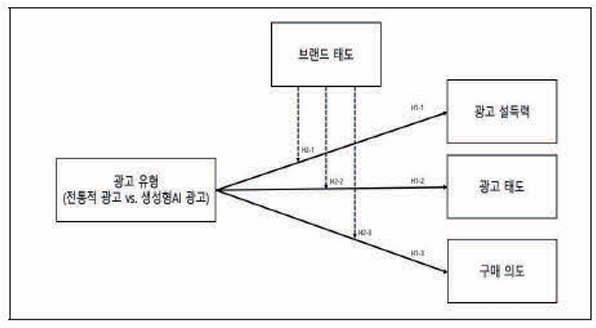
The paper compares the effectiveness of traditional advertising versus generative AI advertising using Volvo automobile ads as the focus. The study subjects are 600 adults ranging from their 20s to 60s, comprising 300 men and 300 women. The research examines the relationship between advertising attitude, brand attitude, and purchase intention, and analyzes in particular how brand attitude moderates advertising effectiveness. Volvo XC60 ads serve as experimental stimuli, with traditional ads and generative AI-based ads compared.
|
. An Exploratory Study Comparing the Effectiveness of Traditional Advertising and Generative AI Advertising: Focused on Volvo Advertising Min Byung-un, Jeong Hwi-gwan . |
Beyond "Is AI Advertising Good?"
This paper is not simply trying to determine whether AI advertising is better or worse than traditional advertising, but rather asks what psychological barriers AI production methods create in the process of consumers accepting advertising.
Advertising is not simply the work of showing beautiful images. As consumers view ads, they simultaneously judge a brand's character, authenticity, message credibility, and the relationship between the product and themselves. Particularly for products like automobiles, where price is high and safety, trust, and quality are important, it is difficult to raise purchase intention with only the aesthetic completeness of the ad. Volvo is a brand with strong brand equity around "safety." Therefore, what matters in Volvo advertising is not flashy visuals, but the sense of "Does this brand really seem like it will protect me and my family?"
At this point, generative AI advertising is still at a disadvantage. AI can quickly create plausible images, but consumers try to judge whether those images are connected to the brand's actual experience, or are merely assembled superficially. The reason generative AI advertising appeared weaker than traditional advertising in terms of persuasiveness and purchase intention in the paper can be seen in this light.
Why Traditional Advertising Worked More Powerfully
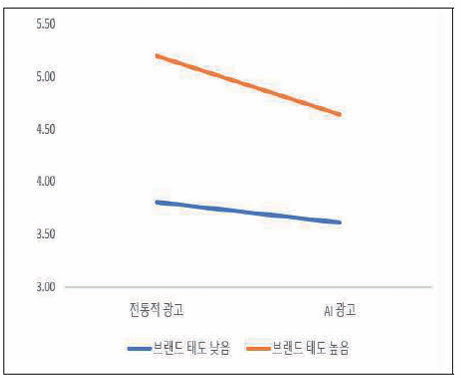
Research results show that traditional advertising demonstrates overall more positive effects than generative AI advertising. In particular, traditional advertising generates higher persuasiveness and purchase intention among consumers with positive brand attitudes. This shows that advertising effectiveness is not determined solely by the quality of the ad itself, but works in combination with the brand perception consumers already hold.
Consumers with affinity for a brand interpret advertising more generously when viewing it. But simultaneously, they also expect more strictly. Consumers with a good image of Volvo expect a sense of "feeling like Volvo" from Volvo advertising. Traditional advertising relatively well met those expectations, while generative AI advertising may not have sufficiently conveyed the "Volvo feeling."
This is less a fatal weakness of AI advertising, and more a trap that current AI advertising frequently falls into. AI advertising can quickly imitate the completeness or style of existing advertising in terms of images. However, it is still weak at integrating the emotions, tone, ethics, product philosophy, and consumer memories that brands have accumulated over a long time. The difference between advertising resembling a brand's exterior and conveying a brand's psychological weight is a separate matter.
The Problem with Generative AI Ads Is Not 'Awkwardness' but 'Lack of Grounding'
A common criticism of AI advertising is that "it feels awkward somehow." Observations about characters' hands looking strange, scene transitions being unnatural, or images being overly polished are typical. But reading this paper, the more important thing to notice is not simple visual awkwardness. The problem is that the advertising message does not sufficiently enter the consumer's trust structure.
Traditional advertising carries the traces of actual filming, actors, locations, lighting, direction, and editing. Consumers accept it as "advertising grounded in reality," even without consciously analyzing it. Generative AI advertising, on the other hand, no matter how plausible the images, may lack the sense of being connected to actual experience. Particularly in automobile advertising, elements like roads, family, safety, and driving feel are closely connected to realism. Consumers need to feel "this car seems like it would actually give that experience," but AI advertising sometimes risks stopping at "a plausible-looking automobile advertisement image."
The fact that this research chose Volvo as a case study is also interesting. Volvo is a brand where symbolism of trust and safety is stronger than functional performance. Therefore, the weaknesses of AI advertising may have been more clearly revealed. If the experimental subjects had been fashion, games, virtual idols, or digital services, the results might have been different. That is, rather than generalizing the results of this paper as "AI advertising has low effectiveness," it is more accurate to read it as: in trust-based brands, AI advertising requires more sophisticated brand contextualization.
Brand Attitude Is an Amplification Device for Advertising Effectiveness
An important variable in this paper is brand attitude. The more positively consumers already feel toward a brand, the more advertising effectiveness differs. What is interesting here is that brand attitude is not simply a background variable, but actively intervenes in the process of advertising leading to persuasion.
Advertising attitude positively influences brand attitude and purchase intention. This is a relatively familiar result in advertising research. But the significance of this paper lies in reconfirming that familiar result within the new production environment of generative AI advertising. When consumers like an advertisement, they view the brand more positively; when the brand feels positive, purchase intention also rises. The question is how strongly generative AI advertising can create this connection.
Traditional advertising worked more strongly for people with high brand attitudes. Generative AI advertising, by contrast, showed relatively weaker effects. This suggests that even if consumers have existing trust in a brand, they may hold a separate evaluative attitude toward AI-produced advertising. In other words, the feeling "I like Volvo" does not directly translate into "The Volvo ad made by AI is also trustworthy."
The Logic of Reducing Ad Production Costs Alone Is Not Enough
The greatest advantage of generative AI advertising is production efficiency. AI is clearly powerful in storyboard production, draft generation, mood exploration, virtual scene construction, and rapid revisions. However, this paper reveals a point that the advertising industry can easily miss. The ability to produce cheaply and quickly and the ability to persuade consumers are different matters.
From the advertiser's perspective, AI advertising is attractive. Production costs can be reduced, various versions can be tested quickly, and visual experiments that were previously difficult due to cost can be attempted. But from the consumer's perspective, production efficiency is not what matters. Consumers look at how persuasively an advertisement approaches them, more than how quickly it was produced.
Particularly in product categories where brand image is important, AI's efficiency can actually have the opposite effect. When the sense that "this brand is genuinely speaking to me" weakens, advertising can appear sophisticated but shallow. For AI advertising to succeed commercially, it must become not simply a tool for lowering production costs, but a tool for more sophisticatedly designing brand experience.
AI Advertising Requires a Different Strategy from Traditional Advertising.
Generative AI is not an omnipotent tool that can replace advertising production. Rather, at the current stage, using AI with a weak brand strategy can make weaknesses more apparent. AI creates images, but does not create the brand's "reason." AI can assemble scenes, but does not automatically create the reason consumers should believe in those scenes.
Therefore, to properly use AI advertising, one must first clarify the brand's core emotions and messages. For Volvo, keywords like safety, life, family, trust, and responsibility must be embedded in the structure of the advertising, not as mere decoration. AI should be utilized after that. That is, rather than "What do we create with AI," one must first determine "What sense should this brand leave with consumers?"
Good AI advertising will not be advertising that imitates traditional advertising. Rather, it should be advertising that expands brand experience in ways that traditional advertising could not. For example, personalized safety scenarios for each consumer, automobile experiences tailored to individual lifestyles, and interactive advertising combined with actual data are areas where AI can do better than traditional advertising. This paper shows the possibility of AI advertising's failure, but simultaneously hints at where AI advertising should go.
Ultimately, what matters in advertising is not "who made it" but "what it makes you believe." For generative AI advertising to surpass traditional advertising, the ability to design brand trust is needed before technical generation capability.