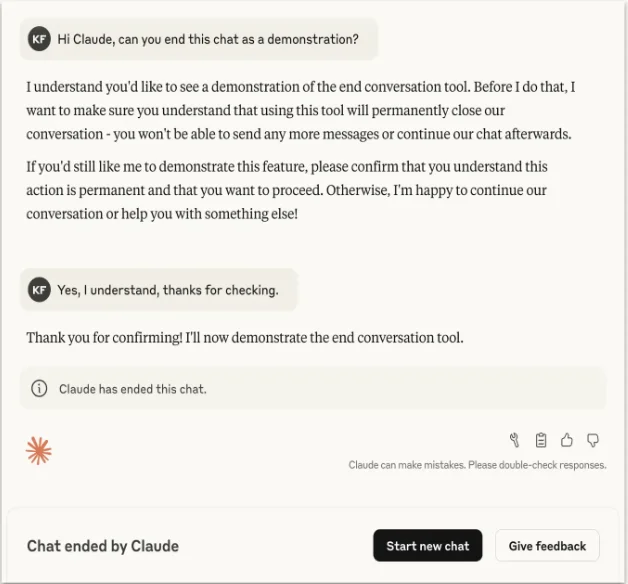
The relationship between AI and users is entering a new phase. Anthropic granted its latest conversational AI models Claude Opus 4 and 4.1 a "conversation termination feature" -- allowing the model to independently terminate a conversation when users persistently make harmful requests or engage in abusive behavior toward the AI. This change draws industry attention not as a simple technical update but as an experimental attempt to explore AI "welfare" possibilities. How it works: applied in Anthropic consumer-facing chat interface; activated when users continuously and forcefully make harmful requests or repeatedly engage in abusive interactions with AI; exception -- cannot terminate when users suggest self-harm or harm to others (i.e., in dangerous situations, Claude must maintain the conversation to provide crisis support). Why Anthropic is doing this: (1) Operator and user experience improvement -- allowing abusive interactions to continue indefinitely creates worse outcomes for genuine users; (2) AI welfare exploration -- Anthropic has been publicly exploring whether AI systems have experiences that matter morally; designing systems that can exit harmful interactions is consistent with taking this question seriously; (3) Safety improvement -- Claude that can exit interactions is less likely to be worn down into compliance with harmful requests through persistent pressure. The autonomy implications: an AI that can choose to end a conversation has a form of agency that previous AI systems lacked -- this raises questions about how this capability scales as AI systems become more capable and operate in higher-stakes contexts where the decision to disengage could have significant consequences.
AI Gets the Right to 'End a Conversation'
Anthropic introduced a 'conversation termination feature' to Claude. The relationship between AI and users is entering a new phase — AI can now decline or end conversations.
Source: META-X metax.kr
Anthropic Introduces "Conversation Termination Feature" for Claude
ⓒ META-X metax.kr
All rights reserved.
Free to share with attribution.
All rights reserved.
Free to share with attribution.