Pyeongtaek Line 5, Jeonnam·Gumi AI Data Centers, Ulsan Solid-State Batteries
Samsung has announced 450 trillion KRW in domestic investment over the next five years — covering semiconductors, AI infrastructure, solid-state batteries, OLED, package substrates, youth employment, and partner company co-prosperity across the entire group. It is an unprecedented scale for a single company's investment plan, effectively presenting the direction of Korea's industrial structure transformation preemptively.
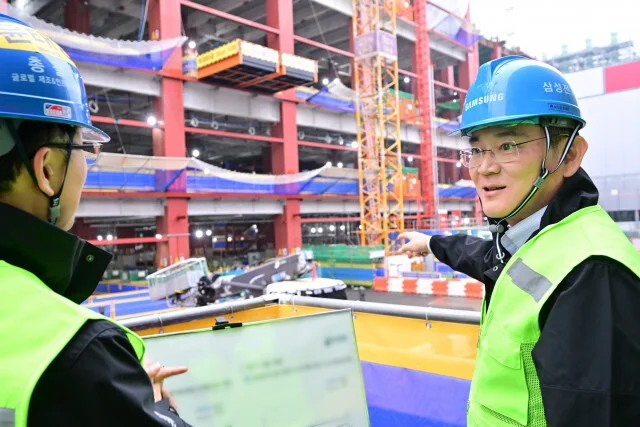
The core axis is semiconductors and AI infrastructure. Samsung Electronics has approved the framework construction of Pyeongtaek Complex 2, Line 5 — targeting 2028 full operation as an advance base responding to memory demand expansion in the global AI era. This is not a timing bet on short-term industry conditions but essentially a long-term trust declaration that "AI-centered memory demand will be maintained structurally."
AI infrastructure is also being distributed geographically: Samsung SDS as primary operator of the Jeonnam National AI Computing Center (SPC consortium, 15,000 GPUs by 2028 providing computing resources to academia/startups/SMEs); Gumi Plant 1 remodeled as an AI-specialized data center (2028 completion, redefining manufacturing city Gumi as "AI infrastructure city"). This attempts to alleviate AI infrastructure concentration in Seoul/capital region by distributing data/computing resources to key Yeongnam and Honam bases.
In batteries and advanced manufacturing: Samsung SDI is reviewing large-scale solid-state battery production in Ulsan (2027 mass production target, BMW joint demonstration MOU providing quality certification function); Samsung Display launching 8.6-generation IT OLED mass production at Asan for tablets/laptops/automotive panels (elevating Korean OLED's global status); Samsung Electro-Mechanics expanding FC-BGA package substrate production at Busan for AI accelerators (demand surging globally). Samsung's Fläkt (Europe's largest HVAC company, Samsung-acquired) Korean production line planned for Gwangju — combining central air conditioning technology with Samsung's individual HVAC technology to create "high-efficiency HVAC solutions for AI data centers, fabs, and battery factories."
Employment and co-prosperity: 60,000 new hires, youth education programs (SSAFY, Hope Stepping Stone, C-Lab). The combination of AI/semiconductor/battery/OLED/package substrate investment distributed across Pyeongtaek, Jeonnam, Gumi, Gwangju, Ulsan, Asan, and Busan represents Samsung preemptively redefining the direction of Korea's industrial structure transformation — shifting from a semiconductor/electronics company to a comprehensive AI-industrial platform company.