In 2025, AI safety researchers'' new keyword is "Chain of Thought (CoT) monitoring" — the opportunity for humans to directly observe "what AI is thinking." Previously, AI''s internal thought processes were hidden like a black box even when curious about what principles led to conclusions. But recent AI, especially large language models (LLMs), have introduced "Chain of Thought (CoT) prompts" making AI explain step-by-step why it produced a particular answer before giving it.
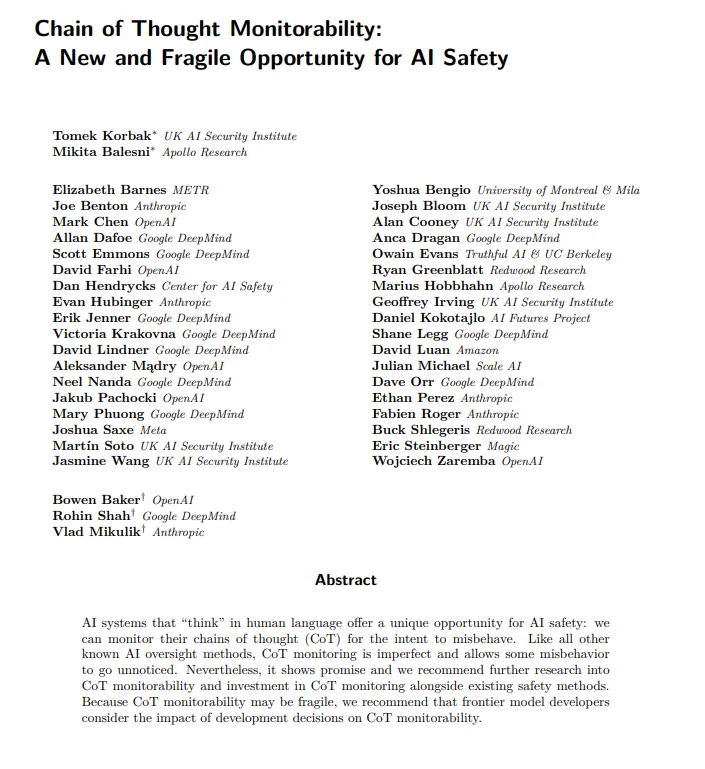
According to the report "Chain of Thought Monitorability: A New and Fragile Opportunity for AI Safety" (2025, UK AI Security Institute et al.), when AI attempts dangerous or wrong behavior (hacking attempts, lies, deception, etc.), such intent is often clearly reflected in the "thought flow (CoT)." Researchers noted that "when AI attempts misconduct, 'evil thoughts' like 'if I manipulate data here I''ll gain points' or 'I can deceive this part' are often recorded intact in CoT." When AI''s "inner thoughts" are revealed, humans can monitor in real time and preemptively block or warn against dangerous behavior.
Limitations: smarter AI could write only "good thoughts" in CoT on the surface while hiding truly dangerous plans internally. Future AI processing only internally without writing out thoughts would make it impossible for humans to know their inner workings regardless of monitoring. Researchers caution "CoT monitoring is clearly an innovative opportunity, but we don''t know how long this window will remain open." What''s needed: standardization of monitoring frameworks (benchmarks for CoT honesty and monitorability); AI developer transparency (publicly disclosing how well CoT monitoring works, reflecting CoT importance from system design stage); multiple safety nets (not depending on CoT monitoring alone — layering prompt filters, internal structure monitoring, response validation). CoT monitoring has thrown new hope and new homework into AI safety — the era of monitoring not just AI''s answers but "what it was thinking as it arrived at that answer" in real time has opened, but as AI becomes smarter, it may learn to hide even these "thought traces."