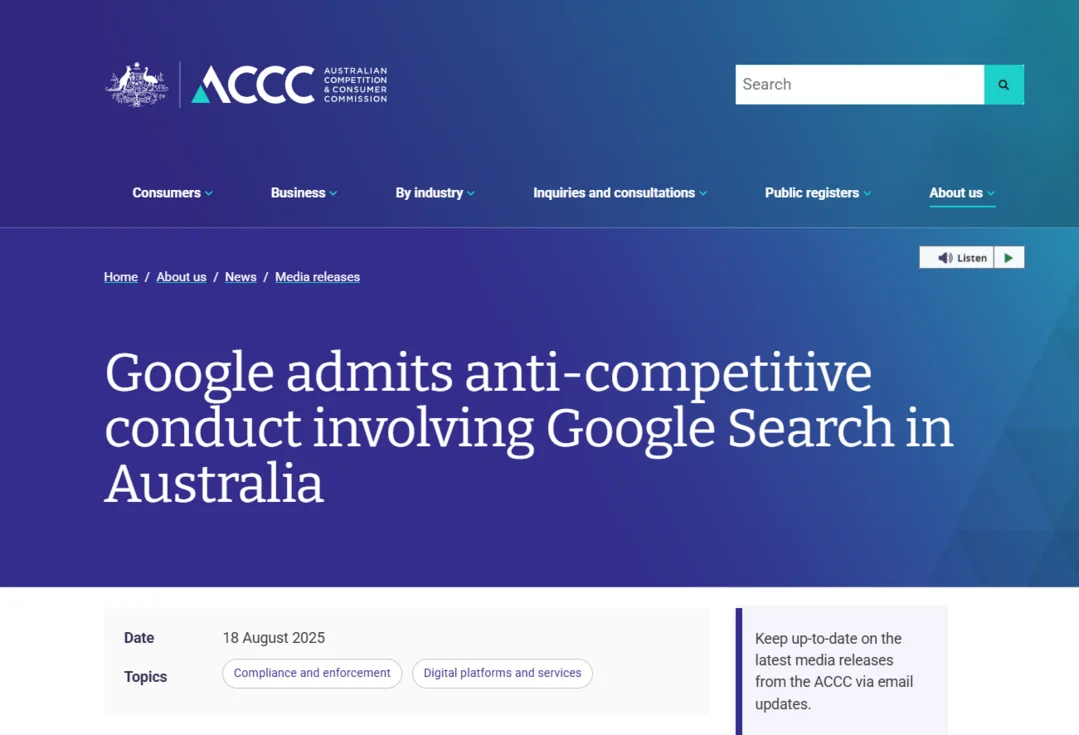
Google admitted that exclusive contracts it made with telecommunications companies to strengthen its search service dominance restricted competition in Australia. The Australian Competition and Consumer Commission (ACCC) filed suit against Google Asia Pacific in federal court on the 18th (local time); Google admitted responsibility and agreed to pay a fine of 55 million AUD (approximately 37 million USD). The problematic contracts: from December 2019 to March 2021, Google required major Australian carriers Telstra and Optus to pre-install only Google search on Android smartphones -- in exchange, both companies received a share of Google search advertising revenue. This arrangement effectively blocked competing search engines from market entry, limiting consumer choice and weakening competition -- what the ACCC determined violated Section 45 of the Competition and Consumer Act (CCA). Under the settlement, Google will pay the fine and provide court-enforceable undertakings to not repeat the conduct. The global context: the Australia settlement is part of a worldwide pattern of regulators challenging Google exclusive search distribution agreements; the US DOJ anti-monopoly ruling found similar exclusive deals with Apple and other browser/device companies constituted illegal monopoly maintenance; the Australia case adds to precedents establishing that revenue-sharing arrangements for default search placement can constitute anti-competitive exclusive dealing even when the agreements are framed as commercial partnerships rather than explicit exclusivity contracts.
Google Admits Anti-Competitive Behavior in Australia — $55M Fine Settlement
Google admitted that exclusive contracts with telecom operators to strengthen search dominance harmed competition. The Australian Competition and Consumer Commission reached a $55M settlement.
Source: META-X metax.kr
Strengthening Digital Platform Regulation Trend
ⓒ META-X metax.kr
All rights reserved.
Free to share with attribution.
All rights reserved.
Free to share with attribution.