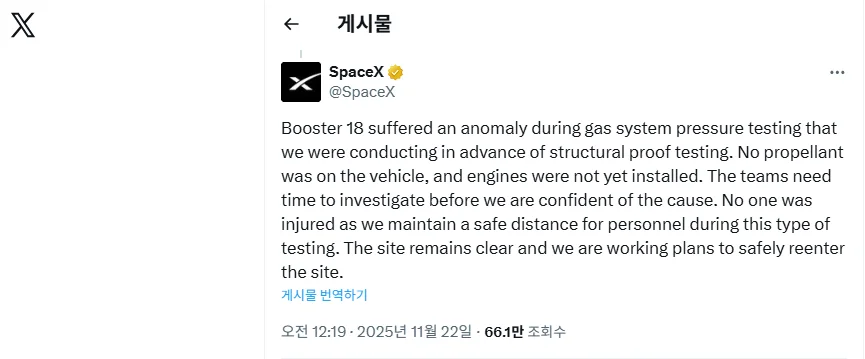
Abnormal Reaction During Gas System Pressure Testing
Early Stage Test Without Propellant or Engines
Structural Questions Posed by Repeated Ground Test Incidents
SpaceX's next-generation launch vehicle "Booster 18" experienced another anomaly during ground testing, prompting new discussions about safety and testing procedures in the Starship development program. The company stated the incident occurred during gas system pressure testing, with no propellant loaded and no engines installed. There were no casualties, and work personnel immediately evacuated to a safe perimeter per test procedures.
SpaceX immediately controlled site access when the anomaly occurred and put subsequent test schedules on hold pending investigation. While the incident is superficially "a limited anomaly during early-stage pressure testing," aerospace experts are noting: the anomaly occurred even without fuel; pressure system-related anomalies are recurring; and SpaceX's rapid test-revise-retest approach structurally increases accident exposure.
Gas system pressure testing is one of the earliest procedures in launch vehicle development — generally classified as relatively low-risk testing to verify tanks, piping, and connections can withstand design pressure before propellant loading. An anomaly occurring even at this stage implies possibilities of structural defects or minor errors in pressure control valves/systems, and risks of design changes or production process variables reflected in the test.
SpaceX has consistently maintained a "fail fast, learn from failure" development structure. Multiple Starship prototype explosions, high-altitude test failures, and booster fixture damage have all been accepted as part of this development approach. The question is whether repeated test failures are simply a learning process or accumulated structural design defects or production quality issues. Starship is not just a SpaceX project — the entire global space industry now depends on Starship timing: NASA's Human Landing System (HLS) program, space cargo/satellite launch price restructuring, Starlink V3 deployment, and mega-satellite group/space exploration vehicle transport plans. While the current incident is not major, recurring anomalies re-highlight the uncertainty of "how flexible is Starship's commercialization timeline."