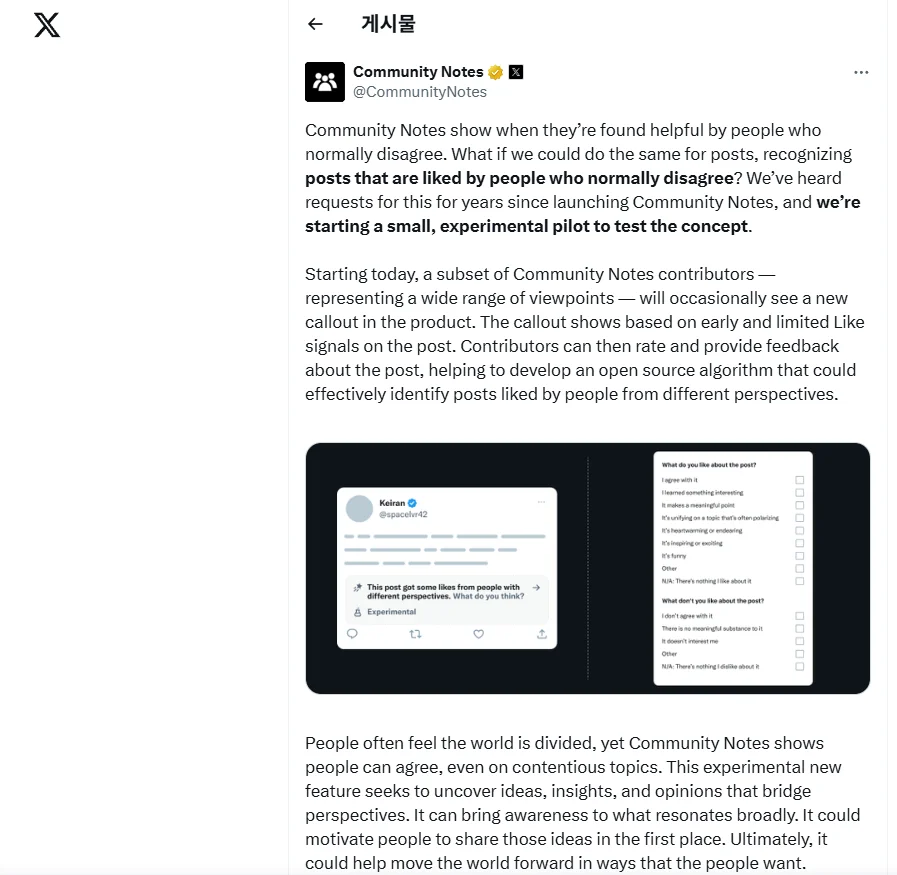
Social media X (formerly Twitter) has started a new experiment identifying "posts that received likes from people with diverse perspectives." Like Community Notes, this is an attempt to visualize "consensus-based trust" based on public algorithms — tracking "empathy amid disagreement" in an online space rife with conflict.
X is currently running an experimental pilot program with some Community Notes contributors in the US, tagging posts that "users with diverse perspectives liked." This experiment is intended to confirm "whether consensus occurred even among people with relatively heterogeneous views" — not simple popular post recommendations but an experiment searching for "signals of civic consensus." Experiment flow: when a post begins receiving initial Likes, some Community Notes contributors receive a new evaluation request (Callout); contributors assess whether the post is "content that people representing diverse perspectives would empathize with"; posts receiving sufficiently positive evaluations receive a "liked by people with different perspectives" tag; all judgments are based on openly published open-source algorithms.
This experiment is an extension of X''s philosophy to design "consensus-based trust" in fragmented information environments. Community Notes already created significant impact by retaining only fact-check information commonly evaluated as "useful" across diverse political persuasions. This time the target expands from "information" to entire "posts" — technically identifying moments of "I disagree with this person, but I also agree with this statement." Unlike recommendation algorithms predicting what users might like, this experiment tracks traces of empathy from people with different opinions — an unusual attempt to surface users'' "points of agreement" in a platform of extreme disagreements. If this experiment expands: SNS recommendation algorithms may partly operate based on "consensus"; "diverse perspective empathy" content may be highlighted in political/social conflict issues; content creators may strategize for "empathy expandability" rather than "extremism." This is not just a feature test but a philosophical question about how platforms can redesign social trust. Now, an attempt has started to focus attention on "posts that diverse people empathized with" — the opposite of "the more controversial, the more exposure."