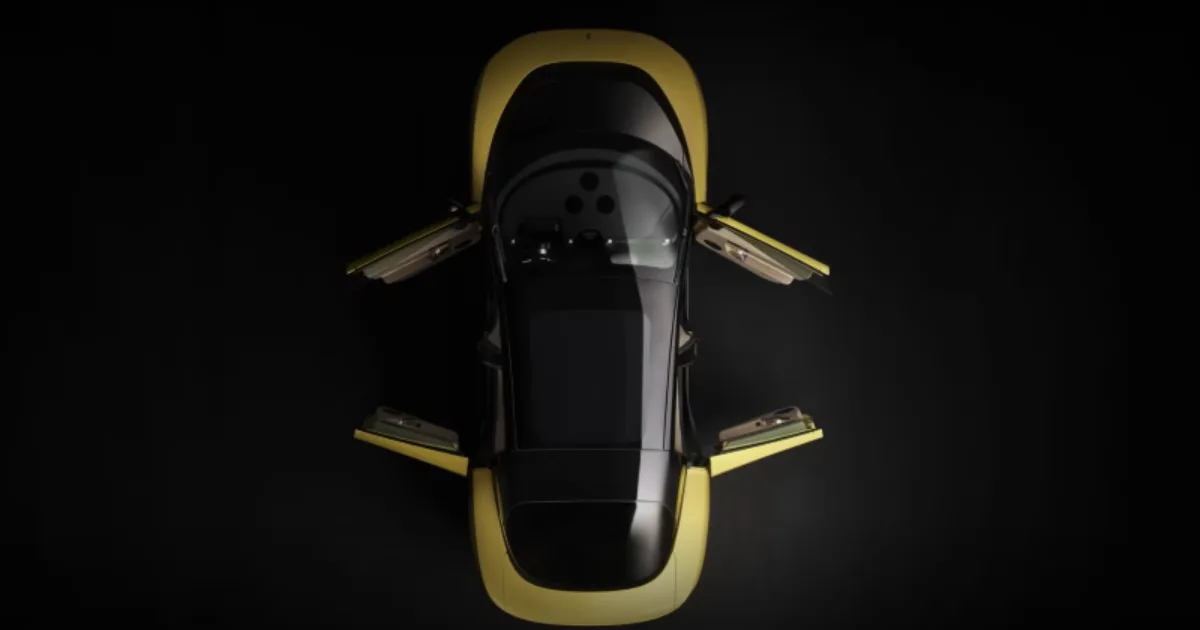
Ferrari has unveiled its first fully electric production car, the Ferrari Luce, opening a new chapter in the history of the Maranello marque. The company introduced the Luce on May 25, 2026, at the Vela di Calatrava in Rome, presenting it as a model that marks a major turning point for one of the world’s most iconic performance brands.
The Luce is Ferrari’s first all-electric production vehicle, equipped with four electric motors, a 122 kWh battery, an 800-volt electrical architecture, all-wheel drive, active suspension and rear-wheel steering. On paper, it looks like a high-performance grand tourer built for the electric era. It produces 1,050 horsepower, accelerates from zero to 100 km/h in 2.5 seconds, reaches 200 km/h in 6.8 seconds and has a top speed of more than 310 km/h. Its estimated driving range exceeds 530 kilometers.
But the significance of the Luce cannot be understood through numbers alone. This is the car through which Ferrari is asking whether it can remain Ferrari in the age of electrification.
Ferrari does not describe the Luce simply as an “electric Ferrari.” The company calls it “an entirely new kind of Ferrari.” Its name, Luce, means “light” in Italian. The message is clear: electrification is not being framed as a crisis that replaces the engine, but as a light that opens new possibilities in design, sensation and user experience.
Why the Luce Is Special: Ferrari’s First EV and First Five-Seater
The Luce is not only Ferrari’s first fully electric car. It is also the brand’s first five-seat model. With four doors and five seats, its structure clearly departs from Ferrari’s traditional formula. If the Purosangue opened a new territory as Ferrari’s first four-door model, the Luce goes one step further by delivering a five-seat layout on an electric architecture.
This change is made possible by the EV platform. In a conventional Ferrari layout, with a front-mid engine and rear transmission structure, creating a true five-seat cabin is difficult. The Luce integrates its battery into the floor and beneath the rear seats, eliminating the central tunnel and expanding interior space. Ferrari says the result is a new kind of car that combines performance, space, driving engagement and usability.
This is not merely an improvement in practicality. It signals Ferrari’s attempt to broaden its customer base and usage scenarios. Traditional Ferraris have been strongly associated with two-seat or 2+2 sports cars. The Luce adds new values: family use, long-distance travel, everyday usability, digital interfaces and quietness.
In other words, the Luce is a Ferrari not only for circuits and mountain roads, but also for cities, daily life and long journeys.
Jony Ive and LoveFrom: Designing an Experience, Not Just a Car
The design of the Luce is not solely the work of Ferrari’s internal design studio. LoveFrom, the design collective led by former Apple design chief Jony Ive and designer Marc Newson, was involved from the early stages of the project. This is an unusual move in the automotive industry. Ferrari’s decision to grant such creative space to an external design group suggests that the Luce required a new design language rather than a continuation of existing models.
The design philosophy of the Luce is based on simplification and integration. The exterior, interior and interface are connected by a single visual language. The central visual element is the glass house. Ferrari describes the Luce’s glass structure as pure and continuous, like a shell. The aerodynamic wings at the front and rear appear to float around the body, while the lighting elements are designed to disappear quietly into the surface when not in use.
This is a different approach from the aggressive and sculptural style traditionally associated with Ferrari. The Luce does not assert its presence through sharp intakes and muscular volume. Instead, it expresses itself through smooth surfaces, airflow, glass and light.
This choice is likely to be controversial. Some traditional Ferrari fans may find it unfamiliar. But Ferrari appears to be using that very unfamiliarity to create a new identity for the electric era.
The Biggest Challenge for an Electric Ferrari: How Should It Sound?
The most sensitive issue in Ferrari’s electrification is sound. Ferrari’s identity has long been tied to engine noise. The voices of its V12, V8, turbocharged and high-revving engines were never just mechanical sounds. They were central to the Ferrari experience.
That makes the question of how to create a “Ferrari-like sound” in a fully electric car both technical and philosophical.
Ferrari says it did not choose an artificial fake engine sound for the Luce. Instead, the company captures real vibrations generated by the electric axles and rotating components using precision accelerometers. These signals are then filtered, equalized and amplified when needed during the driving experience.
Ferrari compares the system to an electric guitar amplifier. Just as an amplifier enlarges the real vibration of guitar strings, the Luce expands the real mechanical texture of its electric drivetrain into sound.
This approach is important. Ferrari’s position is that sound must be real and functional. In other words, it should not be decorative noise designed only to entertain the driver. It should provide feedback connected to acceleration, deceleration, torque changes and driving modes. The Luce’s sound changes according to the e-Manettino mode and paddle operation, allowing the driver to move from quiet concentration to maximum expressiveness.
This is Ferrari’s answer to one of the essential questions facing electric sports cars: do not imitate internal combustion, but do not give up the driver’s emotional connection with the machine.
Four Motors, Four Wheels, One Movement
The technical core of the Luce is its four electric motors, one positioned at each wheel. Each wheel is connected to systems that control drive force, regenerative braking, steering and vertical movement. This allows Ferrari to precisely manage torque distribution, regenerative braking, body posture and directional changes in real time.
The advantage of an electric car is immediate torque. But immediate torque is not always ideal. Strong initial acceleration can feel unfamiliar or excessive to the driver. To address this, Ferrari introduced a unique system in which the right paddle increases available torque levels, while the left paddle adjusts regenerative braking and deceleration feel. This is not an attempt to imitate the gear shifts of an internal combustion car. It is an effort to create a new torque language for electric driving.
The Luce also introduces a new vehicle control unit, or VCU. This system integrates the powertrain and vehicle dynamics into a single functional controller and updates target values 200 times per second. It works together with Side Slip Control X, torque vectoring, active suspension, rear-wheel steering and electronic all-wheel drive.
The result is an attempt to overcome the limitations of a heavy electric vehicle through software and mechanical control. The Luce has a curb weight of 2,260 kilograms, which is not light by traditional sports car standards. However, Ferrari has placed the battery low in the chassis to lower the center of gravity and uses independent control of all four wheels to deliver a more agile driving feel.
Ferrari says the Luce’s center of gravity is 95 millimeters lower than that of the Purosangue, while its yaw moment of inertia is 15 percent lower.
Battery and Charging: Ferrari’s Electric Heart
The Luce’s battery has a capacity of 122 kWh and uses a structure of 210 cells connected in series. Based on an 800-volt architecture, it supports fast charging of up to 350 kW. Ferrari says the battery pack was designed, validated and built in Maranello. The fact that Ferrari developed and produced core components, from electric motors to the battery pack, reflects the company’s broader electrification strategy.
The battery is not merely an energy storage unit. It is also part of the vehicle’s structure. The battery housing contributes to body rigidity, with Ferrari saying bending stiffness has increased by 25 percent and torsional stiffness by 35 percent compared with its previous four-door model. This aligns with the latest trend in electric vehicle platforms, where batteries are integrated as structural components.
The cells are described as pouch-type units jointly designed with SK On. They use a high-nickel NMC cathode, graphite anode and liquid electrolyte, targeting high energy density and strong discharge performance.
This has implications for South Korea’s battery industry. The involvement of Korean battery technology in Ferrari’s first fully electric car shows the strategic position Korean battery makers occupy in the high-performance EV market.
Aerodynamics and Efficiency: Not the Fastest Ferrari, but the Most Slippery
The Luce was developed with the goal of achieving the lowest drag coefficient in Ferrari’s history. Ferrari says it spent more than five years on aerodynamic development, conducting around 6,000 CFD simulations, 250 hours of scale-model wind tunnel testing and 80 hours of full-scale wind tunnel testing. In an EV, aerodynamics are directly linked to range, performance, quietness and thermal management.
The body emphasizes smooth and continuous volume. Protruding shapes, abrupt curvature changes and unnecessary grooves have been minimized. When cooling is not required, active grilles cover the radiators to reduce drag. At high speeds, the active suspension can lower the front of the car by up to 10 millimeters to improve efficiency.
The wheels were also developed for efficiency. The Luce uses the largest staggered wheel diameters ever fitted to a production Ferrari road car, with 23-inch wheels at the front and 24-inch wheels at the rear. The aerodynamically optimized wheels are designed to reduce drag while maintaining brake cooling performance.
Ferrari designed the tires, wheels, underbody and cooling systems as an integrated package to achieve both range and high performance.
A New Interior: More Fingertip Control, Less Touchscreen Dependency
The interior of the Luce is digital, as expected from an EV, but Ferrari has not moved every function into a touchscreen. The company says the interface was designed according to a clear organizational principle of inputs and outputs. Key commands and feedback are placed in front of the driver, while physical buttons, dials, toggles and switches are combined with digital displays.
This is where the involvement of Jony Ive and LoveFrom is most visible. The Luce offers digital functionality, but it does not abandon physical tactility. The steering wheel, e-Manettino, Manettino, torque-control paddles, instrument cluster and central control panel combine mechanical feedback with digital information.
OLED panels developed by Samsung Display are also used in the cabin. The interior includes four OLED displays measuring 12.9 inches, 12 inches, 10.1 inches and 6.3 inches. Materials include Corning Gorilla Glass, recycled aluminum, premium leather and Alcantara.
The Luce’s interior is futuristic, but also tactile. It suggests that Ferrari wants to preserve the feeling that the driver is physically operating the car, even in the electric era.
Ferrari’s Multi-Energy Strategy
Ferrari is not using the Luce to declare the end of internal combustion. Instead, the company emphasizes technological neutrality. It plans to offer customers choices across fully electric, hybrid and internal combustion vehicles. CEO Benedetto Vigna has described the Luce as evidence that Ferrari now combines electric, hybrid and internal combustion sports car architectures.
This reflects the complex reality of the supercar industry. Electrification is unavoidable, but among ultra-high-performance and luxury sports car customers, demand for the emotion, sound and rarity of internal combustion remains strong. While some rival brands are slowing or adjusting their electric supercar plans, Ferrari is introducing an EV not as a replacement for the engine, but as an expansion of the lineup.
The Luce is therefore less a symbol of transition than a symbol of coexistence. Ferrari is interpreting electrification not as the destruction of brand identity, but as an expansion of performance and design possibilities.
Market Debate: Is This a Ferrari or a New Luxury EV?
The market and Ferrari fan base have responded to the Luce with mixed reactions. Some observers have argued that the design moves sharply away from traditional Ferrari aesthetics. The simplified and smooth design language created with LoveFrom may feel distant from Ferrari’s aggressive sculptural heritage. The quietness of the electric drivetrain and the five-seat, four-door layout may also feel unfamiliar to traditional fans.
Others see the Luce as Ferrari’s inevitable evolution. As the auto industry moves rapidly toward electrification and software-defined vehicles, ignoring EVs would pose a greater long-term risk. The Luce arrives at a time when several rival sports car makers are adjusting the pace of their electric transitions. It is expected to be positioned as an ultra-expensive electric vehicle with a price above 500,000 euros.
The key point is that the Luce may not be designed only for existing Ferrari loyalists. It also targets a new generation of super-luxury customers who value design, technology, rarity, space, digital experience and electric performance more than traditional engine sound.
In that sense, the Luce is both an expansion of Ferrari fandom and a redefinition of Ferrari’s customer base.
Implications for Korean Industry: Batteries, Displays and Materials Become the Heart of the Supercar
The Luce sends an important signal to Korean industry.
First, batteries. In high-performance EVs, the battery is not just a component. It is a core system that determines performance, structure, safety, range and brand experience. The use of cells jointly designed with SK On, along with structural integration of the battery pack, shows that Korean battery companies can become important partners in the premium electrification market.
Second, displays. Samsung Display OLED panels are used inside the Luce. In the electric vehicle era, the cabin is increasingly becoming a moving digital space. Automotive competitiveness is expanding beyond engines and chassis into screens, interfaces, sound, connectivity and user experience. Korean display companies may play a larger role in this field.
Third, materials and sustainability. Ferrari says the Luce uses recycled aluminum to reduce CO₂e emissions during production. Even in ultra-high-performance cars, sustainability is no longer optional. It is becoming part of brand credibility. Premium automotive supply chains are moving toward evaluation standards that include not only performance, but also carbon impact, recycling and energy efficiency.
Conclusion: The Ferrari Luce Is Not Just an EV, but an Experiment in Identity
The Ferrari Luce is not simply a new car. It is an experiment in how Ferrari will reinterpret its identity in the electric era. Its four electric motors, 1,050 horsepower, 530-kilometer range, five-seat structure, Jony Ive-influenced design, physical controls, OLED interfaces and sound extracted from real mechanical vibration all converge on a single question.
Can an electric car still be a Ferrari?
Ferrari’s answer is clear. It will not imitate the internal combustion engine. Instead, it will use the structure of an electric vehicle to create a new kind of Ferrari.
The market’s answer is still unfolding. Traditional fans may feel uneasy, while new customers may see the future of Ferrari in that very unfamiliarity.
Like its name, the Luce seeks to illuminate Ferrari’s future. But that light also casts a long shadow between where Ferrari has been and where it must go next.
The most important question is no longer how fast the Luce is. It is whether this car can continue to create the emotion, tension and excitement associated with the Ferrari name in the electric age.