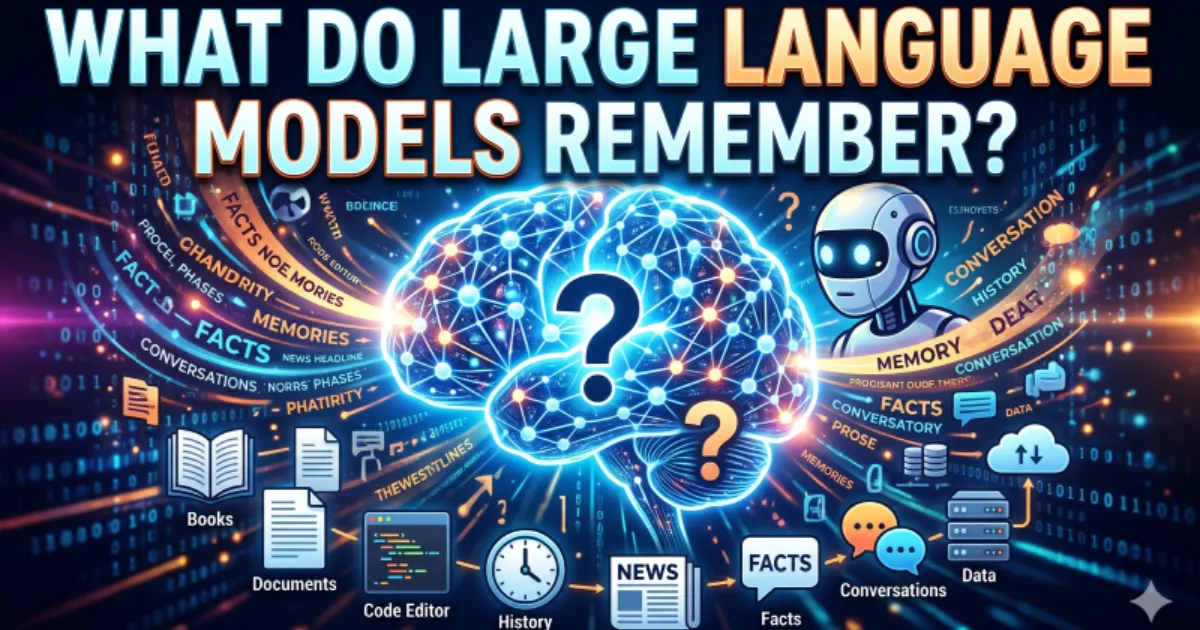
Do large language models truly generate new sentences, or do they sometimes retrieve fragments of the past? This question lies at the center of Extracting Training Data from Large Language Models, a landmark paper by Nicholas Carlini and his colleagues. By examining GPT-2, the researchers demonstrated that large language models can, under certain conditions, reproduce parts of their training data almost verbatim.
The study begins with a challenge to a common assumption in machine learning. If a model is not visibly overfitted, one might assume that it has not memorized its training data in a meaningful or dangerous way. Large language models are trained on enormous datasets, and because their training and test losses may not differ dramatically, they have often been treated as systems that learn broad statistical patterns rather than individual records. Carlini and his co-authors argue that this assumption is incomplete. Even when average overfitting appears limited, rare or unusual pieces of data may remain strongly encoded within the model.
To test this risk, the researchers designed a black-box attack against GPT-2. They did not inspect the model’s internal weights or architecture. Instead, they queried the model from the outside, generated large volumes of text, and then searched for outputs that appeared unusually likely to have come from the training data. Their method involved two main stages. First, they sampled text from GPT-2. Second, they ranked the generated samples using several signals, including likelihood scores, zlib compression, comparisons with smaller GPT-2 models, and changes in perplexity after lowercasing the text. In effect, they looked for sentences that the model produced with suspicious confidence.
The results were striking. Out of 1,800 candidate samples, the researchers identified 604 unique examples of memorized training data. In some experimental settings, as many as 67 percent of the selected candidates matched actual training data. More importantly, the extracted data was not limited to generic web text. The researchers found names, phone numbers, email addresses, physical addresses, source code, UUIDs, URLs, and log files. Some pieces of information appeared in only a single document in the training corpus, yet GPT-2 was still able to reproduce them.
The significance of this paper is that it shifts the privacy debate around generative AI from data collection to model output. Traditional privacy discussions have focused on what data is collected, whether users consented to its use, and where that data is stored. This study shows that once data has been used for training, parts of it may persist inside the model and later reappear in a different context. From the perspective of Helen Nissenbaum’s theory of contextual integrity, this matters deeply. Even information that was once publicly available can become a privacy violation when it is reproduced outside its original context.
Another important finding concerns model scale. The researchers found that larger models tended to memorize more training data. This conclusion carries serious implications for the AI industry’s scaling strategy. Until now, the race to build larger models has largely been framed around performance, generality, reasoning ability, and commercial competitiveness. But this paper warns that scale may also increase privacy risk. A more powerful model may not only understand language better; it may also remember more of the data it was trained on.
The strength of the study lies in its empirical approach. Rather than making a theoretical claim about possible risks, the authors tested an actual publicly released language model and showed that training data extraction was possible. They also avoided relying on a single detection method. By combining different sampling strategies and ranking metrics, they demonstrated that memorization was not merely an accidental artifact of one measurement technique, but a structural risk that may exist across large language models.
The paper also has limitations. Its main target was GPT-2, and the training data consisted largely of publicly scraped web text. Therefore, its exact findings cannot be directly generalized to today’s most advanced commercial LLMs, closed models, or chatbot systems refined through reinforcement learning and safety alignment. The attack was also closer to an untargeted extraction attack than a targeted attempt to recover a specific person’s information. Even so, these limitations do not weaken the paper’s importance. Instead, they clarify why further research is necessary.
The implications for AI governance are substantial. First, de-identification and filtering of training data are not enough. Regulators, developers, and auditors must also examine how data is memorized and reproduced by trained models. Second, technical safeguards such as differential privacy may become increasingly important, although applying them to large-scale language models remains difficult because of performance and cost trade-offs. Third, independent auditing systems may be needed to test models for memorization risks before and after deployment.
Ultimately, the paper raises one of the most fundamental questions of the generative AI era: What does it mean for an AI system to learn? Is learning merely the discovery of patterns, or does it also involve the retention of fragments of the world? As large language models become more fluent and more capable, they may also carry traces of someone’s sentence, code, record, contact information, or forgotten digital footprint.
Extracting Training Data from Large Language Models remains a turning point in the study of generative AI privacy. It reframes AI risk not only as a problem of hallucination, bias, or inaccurate output, but as a deeper structural issue involving the persistence and reproduction of training data. As AI models continue to grow and absorb more information, the warning offered by this study becomes increasingly relevant. Trust in generative AI will not come only from better answers. It will also depend on whether these systems can be controlled in terms of what they must not remember.