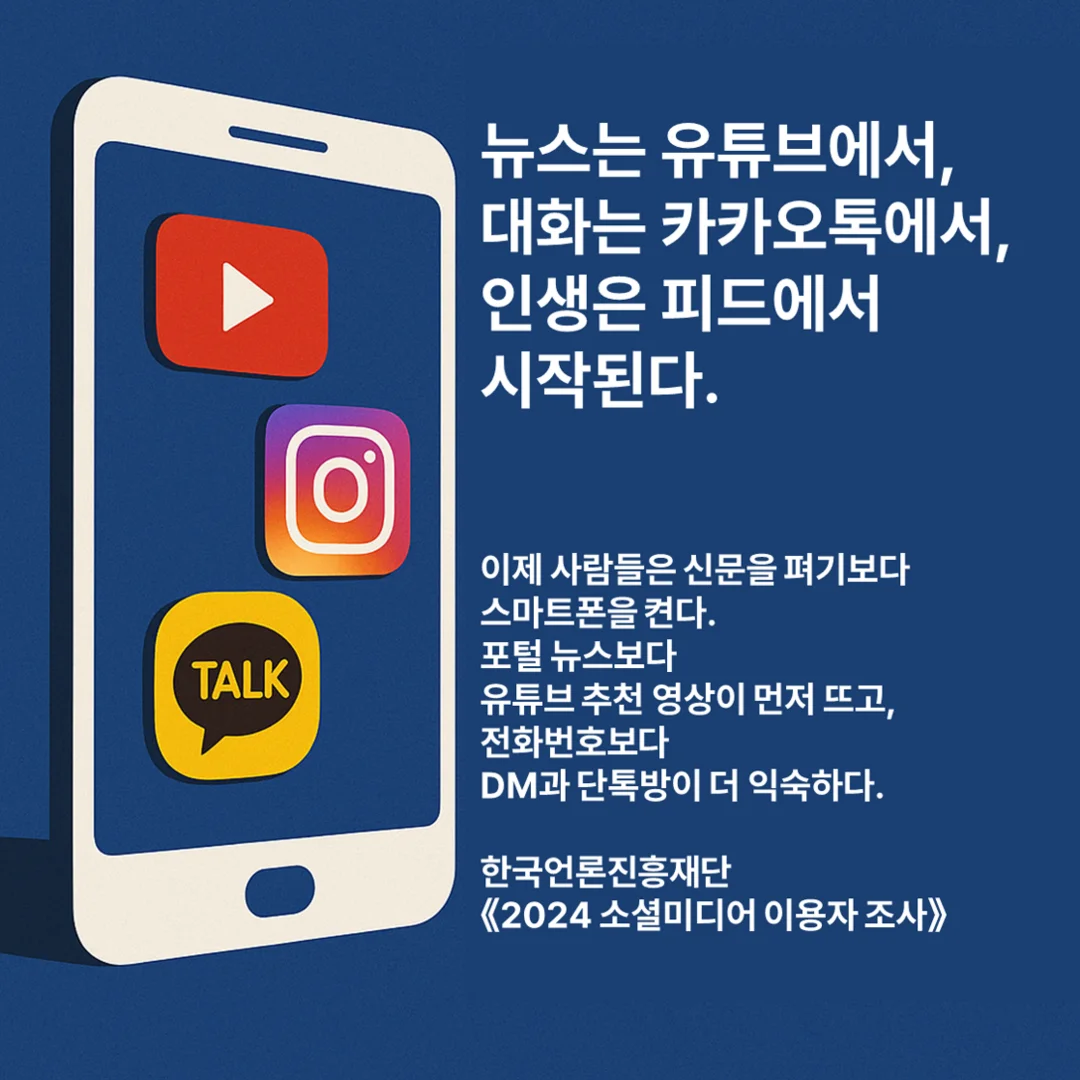
"News from YouTube, conversations from KakaoTalk, life begins in the feed." People now turn on smartphones rather than opening newspapers. YouTube recommended videos appear before portal news, and DMs and group chats are more familiar than phone numbers. The Korea Press Foundation 2024 Social Media User Survey shows these changes in statistics -- survey of 3,000 people nationwide: Koreans use an average of 4.25 social media platforms; KakaoTalk (98.9%) and YouTube (84.9%) overwhelmingly ranked 1st and 2nd. Platform rankings: 1st KakaoTalk 98.9%; 2nd YouTube 84.9%; 3rd Instagram 62.7%; 4th NaverBand 39.0%; 5th Facebook 37.5%; 6th TikTok 30.2%; 7th NaverCafe 25.0%. Purpose differentiation: KakaoTalk dominates "communication/messaging" purpose (94.3%); YouTube dominates "video content consumption" (87.2%) and "news consumption" (54.8%); Instagram leads "lifestyle/trend information" (48.6%); TikTok gains traction in "entertainment/short-form" (51.3% among users). Age differences: 10s-20s -- TikTok penetration 58.9%, Instagram 76.4%, YouTube 91.2%; 30s-40s -- KakaoTalk near-universal, NaverBand for community, YouTube dominant; 50s+ -- KakaoTalk and YouTube dominant, other platforms drop sharply. News consumption through social media: 70.4% of respondents access news through social media; YouTube is the primary social news source for all age groups except teens; algorithmic curation of news creates filter bubbles -- 67.8% of users believe their social media news feed mostly shows perspectives they already agree with. Short-form dominance: average video content consumption time shifted from 10+ minute videos (2020) to 2-3 minute videos (2024); YouTube Shorts, TikTok, and Instagram Reels have driven this shift; the implications for in-depth journalism are significant -- the attention economy is shifting toward formats incompatible with complex analytical reporting. The creator-as-media phenomenon: 43.2% of respondents say they "follow specific creators" rather than "follow specific media organizations" for news and information; creator-trust exceeds institutional media trust for respondents under 40; this structural shift from brand-trust to person-trust in information consumption represents a fundamental challenge to traditional media authority.
Korea's Social Media Ecosystem — 'News From YouTube, Conversations on KakaoTalk'
Korea Press Foundation's 2024 Social Media User Survey. 'News starts on YouTube, conversations on KakaoTalk, and life on the feed.' People now reach for smartphones instead of newspapers.
Source: META-X metax.kr
Korea Press Foundation 2024 Social Media User Survey
ⓒ META-X metax.kr
All rights reserved.
Free to share with attribution.
All rights reserved.
Free to share with attribution.