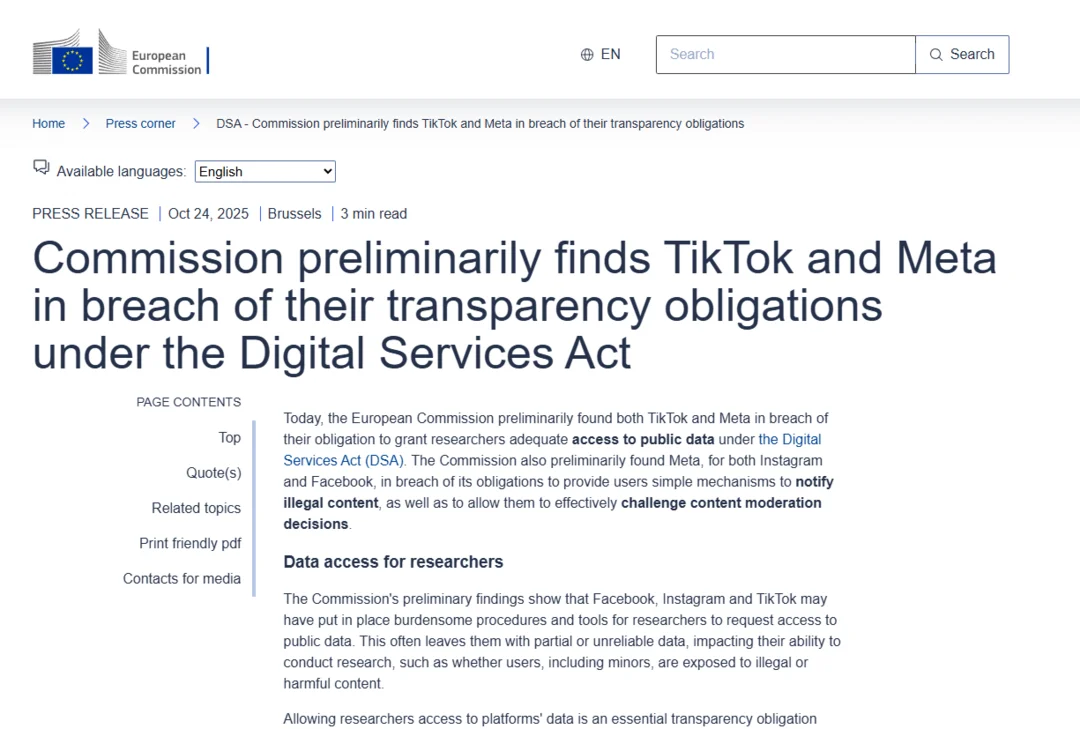
EU Commission issued preliminary findings that TikTok and Meta (including Facebook and Instagram) violated "researcher data access rights" and "illegal content reporting procedures" obligations under the Digital Services Act (DSA) -- not simply a regulatory measure but a European digital sovereignty declaration around platform governance transparency and accountability. October 24, 2025: EU Commission stated that both TikTok and Meta failed to properly implement "obligation to allow researchers access to public data" and "obligation to guarantee users right to report illegal content and file appeals" under DSA. EU investigation findings: both platforms made researcher access request procedures excessively complicated, or provided data that is "partial or unreliable" -- making it difficult for researchers to conduct studies verifying social impacts of content exposure to minors, hate speech, and misinformation propagation. Meta specifically also failed EU standards in the "Notice and Action" system for illegal content reporting and the "Content Moderation Appeals" function for disputing content removal decisions. The DSA transparency requirements: platforms must maintain searchable ad repositories; provide researcher data access to vetted researchers; report transparently on content moderation actions; allow users to contest moderation decisions. The EU enforcement escalation: preliminary findings typically lead to formal findings if platforms do not remediate; formal findings enable fines up to 6% of global annual revenue; for Meta (approximately $135B 2024 revenue), 6% would be approximately $8.1B; for TikTok, 6% of ByteDance global revenue would be proportionally significant. The researcher access provision is particularly significant because it enables civil society oversight of platform algorithms -- without it, platform claims about content moderation effectiveness cannot be independently verified.
EU Makes Preliminary Ruling Against TikTok and Meta for 'Transparency Obligation Violations'
Platform accountability in the Digital Services Act era goes back on the test bench. The European Commission made preliminary rulings that TikTok and Meta violated their transparency obligations under the DSA.
Source: META-X metax.kr
Platform Accountability in the Digital Services Act Era Again on the Test Stand
ⓒ META-X metax.kr
All rights reserved.
Free to share with attribution.
All rights reserved.
Free to share with attribution.