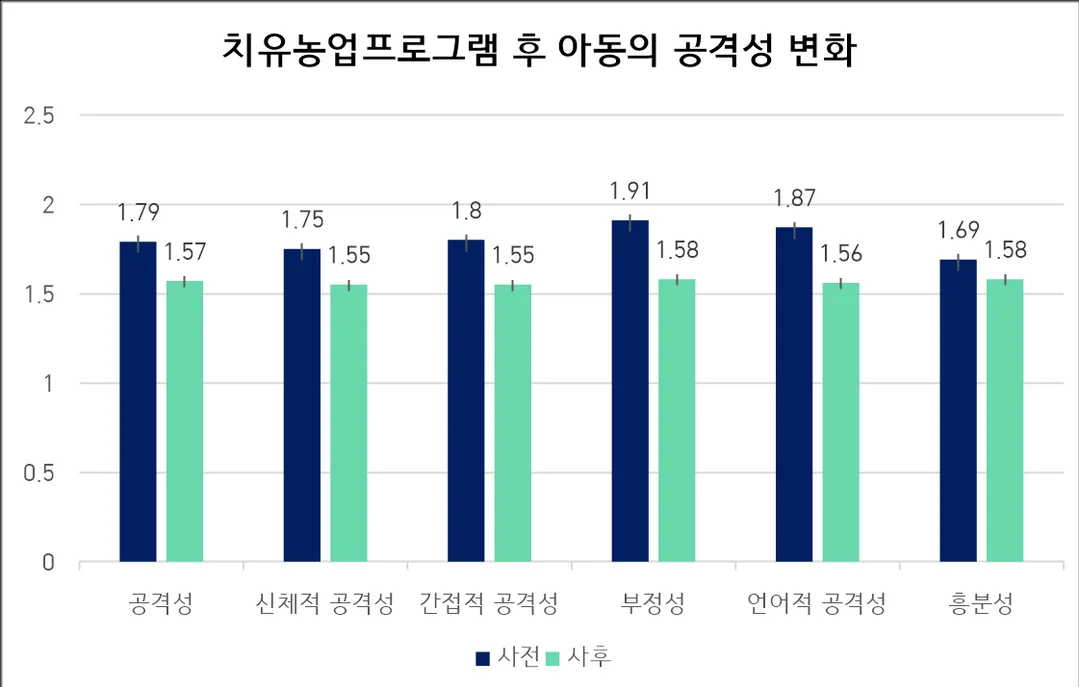
Konkuk University Digital Humanities and Healing Agriculture Convergence Research Center (CRC, Center Director Lee Chung-hwan) research team verified the effect of healing agriculture programs on reducing children aggression in research conducted with support from the Ministry of Science and ICT and Korea Research Foundation. This research targeted 30 elementary school 4th-6th grade students who participated in an 8-week healing agriculture program, comparatively analyzing psychological changes before and after the program. Research results: children overall aggression decreased significantly after program participation. Particularly, physical aggression, verbal aggression, and hostile attitude (sub-factors of aggression) all showed meaningful reductions. The healing agriculture program elements: students engaged in soil-based gardening activities (planting, nurturing, harvesting), animal interaction (small farm animals), and nature-based sensory experiences; the research measured aggression using validated scales before and after the 8-week program. Why healing agriculture reduces aggression: contact with natural elements reduces cortisol (stress hormone) levels; responsibility for living things (plants, animals) builds empathy and self-regulation; non-competitive, process-oriented activities reduce the pressure triggers that contribute to aggressive behavior; the physical activity component of gardening provides healthy stress release; community of care (students working together to nurture shared plants) builds prosocial connection. The policy implication: school-based healing agriculture programs offer a cost-effective, evidence-based intervention for children showing early signs of behavioral difficulties -- the 8-week format is practical for school integration without major curriculum disruption.
Konkuk University Research Center Verifies Effect of Healing Agriculture Program in Reducing Child Aggression
[Korean article] 건국대 디지털인문치유농업 융합연구센터, 치유농업 프로그램을 통한 아동 공격성 감소 효과 검증
Source: META-X metax.kr
ⓒ META-X metax.kr
All rights reserved.
Free to share with attribution.
All rights reserved.
Free to share with attribution.