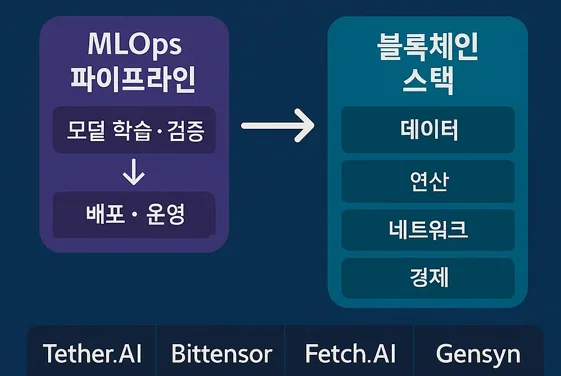
Examining Core Innovation and Strategic Implications of Tether.AI, Bittensor, Fetch.AI, and Gensyn.
Tether''s AI entry announcement ("Tether.AI") highlights a broader trend: cryptocurrency and blockchain technology moving beyond traditional finance/payments into AI system design and operations. Centralized AI services have shown structural limitations (single point of failure, excessive data collection, high API costs) — decentralized AI platforms propose blockchain-integrated alternatives. Four project analysis: (1) Bittensor — decentralized ML training platform: "Synapse" distributed node network; automated model exchange and peer review for performance/reliability verification; TAO token staking determines node ranking and rewards; Model Marketplace for trading verified models; enables AI R&D without centralized cloud dependence; (2) Fetch.AI — autonomous agent deployment and operations: AI agents executing complex multi-step tasks without human intervention; FET token economy aligning agent service providers and consumers; particularly strong for supply chain optimization, financial trading, and IoT automation use cases; (3) Tether.AI — announced as an on-device AI inference platform leveraging Tether''s existing USDT/XAUT infrastructure for AI service micropayments; positions Tether as both AI infrastructure provider and payment layer; (4) Gensyn — distributed compute marketplace: matching ML training workloads with underutilized GPU capacity globally; cryptographic verification of correct computation (key innovation — proving GPU actually executed the claimed training work); GEN token rewards compute providers. Integration framework: these four platforms address different layers of the AI development pipeline (training, verification, deployment, payment) — together enabling a complete decentralized AI infrastructure stack that theoretically eliminates dependence on AWS, Azure, or Google Cloud for AI development.