Remaining Tasks: Expanding Scope, Concretizing Dangerous AI Concept, People
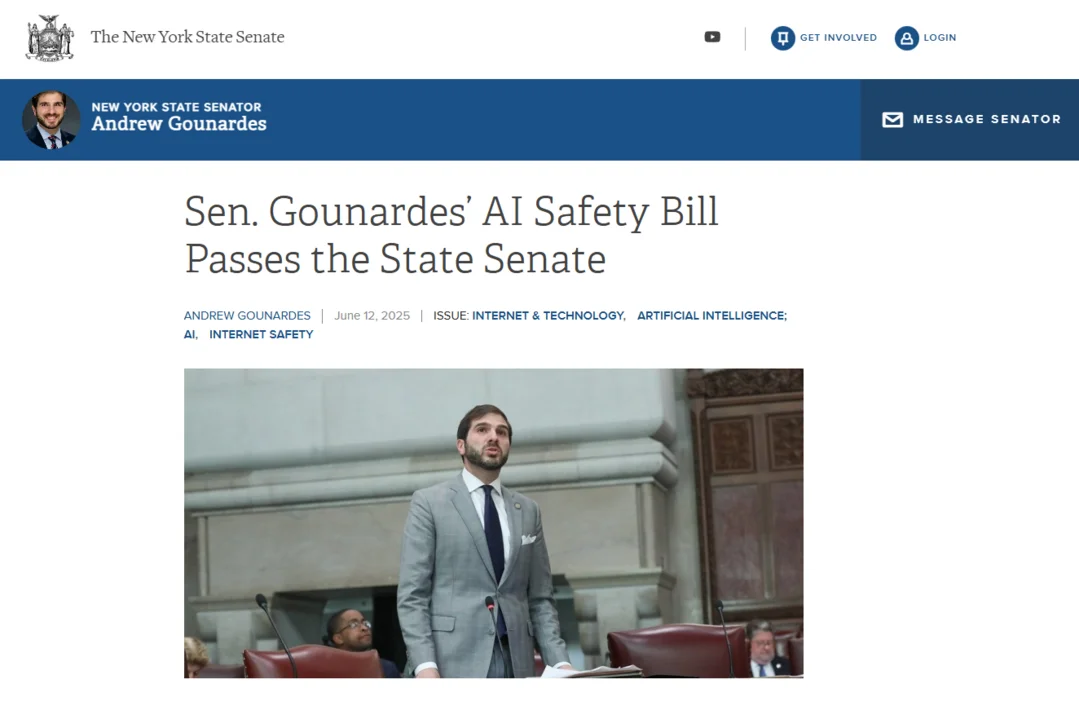
June 12, 2025: New York State Senate established the first safety device for the AI era. The "RAISE Act (Responsible AI Safety and Education Act)" introduced by State Senator Andrew Gounardes passed the Senate -- positioning New York as a leader in AI safety legislation. This law responds to realistic risks that AI could help create biological weapons, execute automated crimes, or be hijacked by malicious hackers. For large companies training high-performance AI models with investment of 100 million USD or more, establishing a "safety plan" to prevent such risks is legally mandated. The three core obligations: (1) Safety plan requirement -- companies training frontier AI models must develop, maintain, and publish safety plans describing how they test for dangerous capabilities and what measures prevent misuse; (2) Hazard testing obligation -- before deployment, companies must conduct specific tests for CBRN (chemical, biological, radiological, nuclear) weapon assistance capabilities, critical infrastructure attack capabilities, and cyberweapon creation; (3) Post-deployment monitoring -- ongoing monitoring requirements to identify if deployed models are being used for harmful purposes. The New York advantage: California SB 1047 was vetoed by Governor Newsom in 2024; RAISE Act passing the Senate represents a new legislative front; if signed by the Governor, it would establish the first US statewide mandatory AI safety testing requirements for frontier models. The criticism: AI companies argue the 100M USD training threshold captures the wrong companies and safety plans may be satisfied with performative compliance rather than genuine safety investment.