Seeking Balance Between AI Innovation and Creator Protection
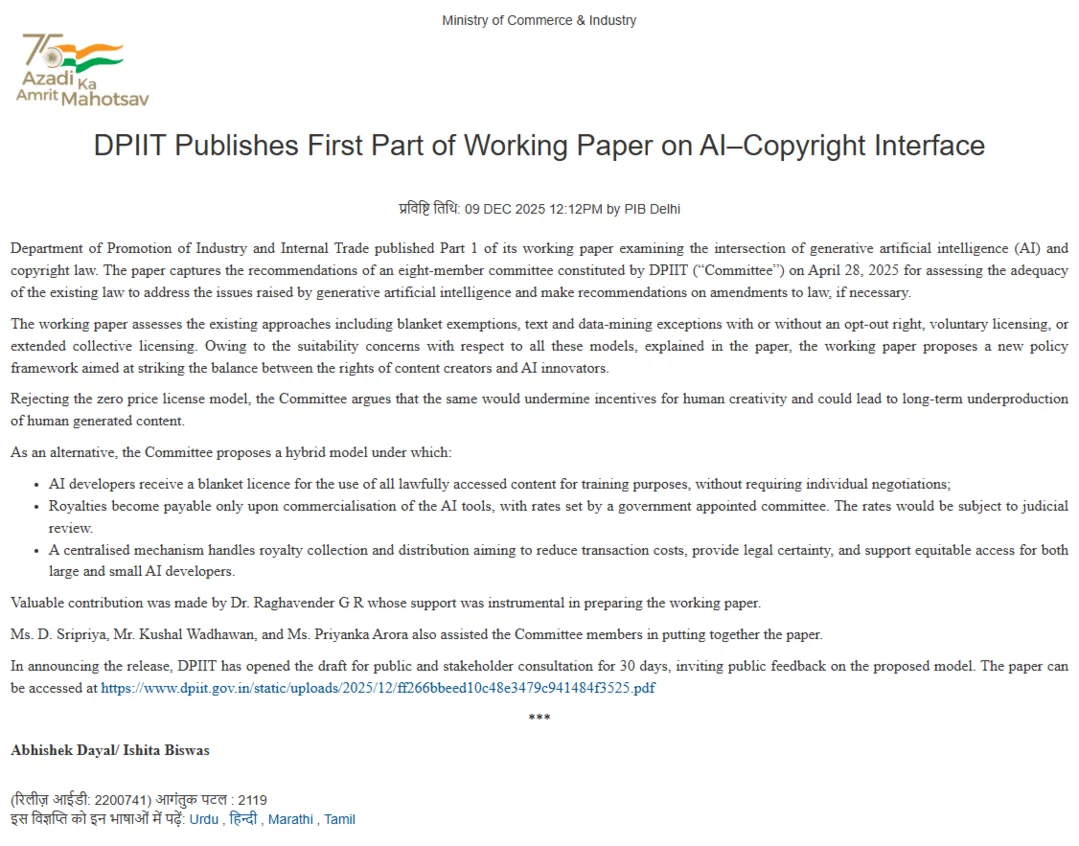
The Indian government has presented an independent policy solution for the collision point between generative AI and copyright, emerging as the center of global AI norm discussions. India Department for Promotion of Industry and Internal Trade (DPIIT) officially released Working Paper 1 addressing the relationship between generative AI and copyright law on December 9, 2025, formally launching policy discussions including future institutional reform possibilities. Background: an 8-person committee formed April 28, 2025, reviewed for approximately 8 months -- focusing on whether existing copyright frameworks sufficiently address new legal/economic issues that generative AI raises. The global approaches reviewed: blanket exemption for AI training, text/data mining (TDM) exception provisions (with or without opt-out), voluntary licensing, Extended Collective Licensing (ECL). However, the committee found all these models have limitations in the Indian context and for long-term creative incentives. India proposed hybrid model: (1) Mandatory licensing/royalty system for AI training on protected content -- not free use but not blocking either; (2) Opt-out mechanism allowing rights holders to exclude their content; (3) Fair remuneration framework ensuring creators share in the commercial value AI systems generate from their work. Significance: India is proposing a "middle path" between the US approach (permissive, market-based) and EU approach (prescriptive, rights-based) -- reflecting both India ambitions as a major AI development nation and its large creative economy with legitimate interests in protecting creators.