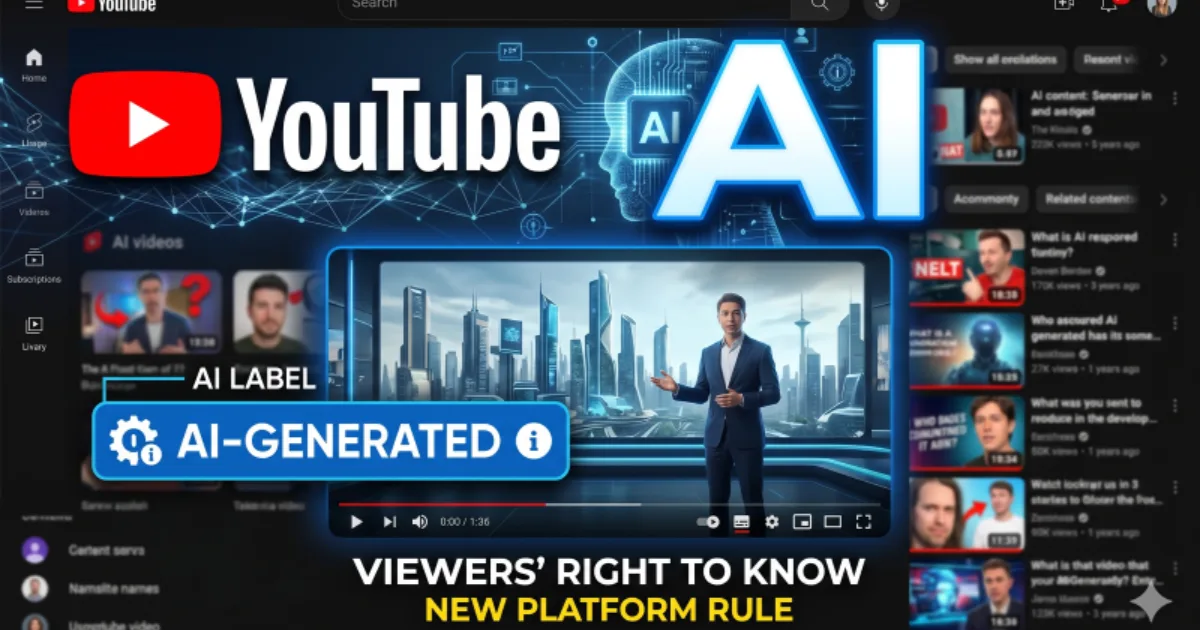
YouTube is significantly strengthening how it labels generative AI content. In an official blog post published on May 27, 2026, the platform said it will make labels for AI-generated or meaningfully altered content more visible, while also introducing internal signals to automatically detect whether realistic AI-generated content has been used.
The change has two central elements. First, labels for realistic AI-generated or meaningfully altered content will no longer remain buried deep in the video description. For long-form videos, the label will appear directly below the video player and above the description box. For Shorts, it will appear as an overlay on the video itself. Second, even if creators do not disclose their use of AI, YouTube may automatically apply a label when its systems detect a significant level of realistic AI use.
This marks an important turning point in the distribution of generative AI content. Until now, platform policies around AI disclosure have largely relied on creators voluntarily reporting their use of AI tools. But as AI-generated video becomes more realistic and content resembling real people, places and events becomes more common, voluntary disclosure alone is increasingly insufficient to protect viewers’ ability to judge what they are watching.
YouTube’s latest move shows that the platform is shifting from a system that waits for creators to disclose AI use to one in which the platform itself identifies and labels AI-generated content.
Why AI Labels Have Become More Important
The core issue with generative AI content is not simply whether AI was used. The deeper problem is that viewers are finding it harder to distinguish between real footage, AI-generated imagery and real video that has been meaningfully altered by AI.
YouTube is one of the world’s largest video platforms. It hosts news, education, entertainment, political commentary, product reviews, health information, financial advice and many other forms of content. In such an environment, if realistic AI-generated video spreads without clear labeling, viewers may confuse real scenes with synthetic ones, human speech with AI-generated speech, and actual events with fictional reconstructions.
This is why YouTube emphasized terms such as “photorealistic” and “meaningfully altered or generated” in its announcement. Not every use of AI carries the same level of risk. Using AI to create background music, slightly adjust color tones or produce unrealistic animation is very different from generating a video that appears to show a real person or event.
YouTube’s policy therefore focuses on AI content that can affect viewers’ perception of reality. Realistic and meaningfully altered AI content will receive more visible labels, while unrealistic, animated or lightly edited content may be identified in the expanded description area. This indicates that AI content governance is moving away from regulating AI use itself and toward managing content that could distort viewers’ understanding of reality.
From the Description Box to the Main Stage
The most visible change in the new policy is the placement of the label. Previously, AI-use disclosures often appeared in the description box or other expanded information areas. But descriptions are easy to miss unless viewers actively open them. In the case of Shorts, where videos are consumed quickly and continuously, checking the description is rarely central to the viewing experience.
To address this, YouTube will place AI labels for long-form videos directly below the player and above the description. For Shorts, the label will appear as an overlay on the video itself. The goal is to ensure that viewers can recognize AI use without taking any additional action.
This may seem like a small interface change, but it is significant. On a platform, the location of information determines its power. The same disclosure has a very different effect when it appears at the bottom of a description box than when it appears directly below the video. By moving AI labels to what it describes as the “main stage,” YouTube is effectively making AI transparency a core part of the viewing experience.
Automatic Detection Addresses the Limits of Voluntary Disclosure
The more important change is automatic AI detection. YouTube said it is introducing new internal signals in May 2026 to help identify AI-generated content. Creators are still required to disclose realistic AI use. However, even if they fail to do so, YouTube may automatically apply a label when its systems detect a significant level of realistic AI-generated or altered content.
This is a major shift in platform governance. Until now, AI content disclosure has depended heavily on the goodwill and understanding of creators. But not every creator can accurately determine whether a tool or workflow requires disclosure. Some may deliberately hide AI use, while others may simply not know that their content falls under the policy.
Automatic detection is designed to close that gap. By analyzing content directly and applying labels when necessary, YouTube is taking a more active role in protecting viewers’ right to contextual information.
At the same time, this approach may raise new questions. AI detection technology is not perfect. Real footage could be wrongly identified as AI-generated, while highly sophisticated AI-generated video could evade detection. YouTube appears to recognize this risk and has preserved some degree of creator control. If creators believe their content has been incorrectly labeled, they can update the disclosure status in YouTube Studio.
However, some labels may remain permanent. This applies to content created with YouTube’s own AI tools such as Veo or Dream Screen, as well as content whose C2PA metadata indicates that it is fully AI-generated.
C2PA and the Rise of Trust Infrastructure
Another important element in YouTube’s announcement is C2PA metadata. C2PA is a technical standard designed to verify the origin and editing history of digital content. It can record whether an image or video was created or edited using AI tools, and it can help platforms and viewers understand the provenance of a piece of media.
By incorporating C2PA metadata into its labeling system, YouTube is connecting AI content governance to a broader layer of technical trust infrastructure. In the future, generative AI content may not be judged only by whether a creator says AI was used. It may also be evaluated based on what origin information is embedded within the content itself.
This could reshape the digital content ecosystem over time. If cameras, editing software, AI tools and platforms all begin to share content provenance information, trust in online video will no longer depend only on individual platform judgment. It will increasingly become a matter of industry-wide standards.
What This Means for Creators
The new policy sends an important signal to creators. YouTube said that receiving an AI label alone will not affect a video’s recommendation or monetization eligibility. This is intended to reduce concerns that creators will be penalized simply for disclosing AI use.
Still, the long-term responsibility of creators is likely to grow. AI tools will become increasingly common in video production, but knowing when and how to disclose their use will become a basic part of creator literacy. This will be especially important in areas where trust is critical, such as videos involving real people, news events, health information, financial advice, political content and educational materials.
Creators should not necessarily view AI labels as a negative signal. Clear disclosure can help preserve trust with audiences. The problem is not the use of AI itself, but using it in a way that misleads or confuses viewers. In the years ahead, creative competitiveness may depend not only on how well creators use AI, but also on how transparently and responsibly they explain that use.
What This Means for Viewers
For viewers, the change is more direct. YouTube says the labels are designed to help audiences understand the context of what they are watching. This reflects a broader reality: in the age of AI-generated media, media literacy can no longer be left entirely to individual judgment.
In the past, video was often treated as stronger evidence of reality than photographs. The assumption was simple: if there is video, it must have happened. Generative AI is weakening that assumption. A scene that looks real may not have been filmed. A video that appears to show a public figure speaking may not reflect an actual statement. A realistic background and realistic people do not necessarily mean that the event occurred in the real world.
AI labels are a minimal guidance system designed to reduce this confusion. They will not solve every problem. Some viewers may miss the labels, while others may misunderstand what they mean. But by moving contextual information closer to the viewing experience, YouTube is taking an important step toward helping audiences interpret AI-era content more critically.
No Direct Impact on Recommendations or Monetization — But Questions Remain
YouTube has said that the AI disclosure label itself will not directly change whether a video is recommended or monetized. This emphasizes that the policy is intended as an information tool, not a punishment mechanism.
However, this explanation also raises important questions. If AI labels do not affect recommendations or monetization, how should platforms manage AI content that carries a high risk of misinformation or manipulation? Conversely, if labels influence viewer trust or click-through rates over time, could recommendation systems indirectly respond to those behavioral changes?
For now, YouTube’s position is clear. A label does not automatically mean a video will be restricted or demonetized. But if AI-generated content is connected to misinformation, fraud, defamation, impersonation, election manipulation or child safety risks, it may still fall under existing community guidelines or other platform policies.
In that sense, AI labels should be understood less as enforcement tools and more as transparency tools. Their purpose is to give viewers context, not to automatically penalize creators.
The Next Stage of Platform Regulation
YouTube’s new AI labeling policy is a starting point, not an endpoint. More complex issues are likely to follow.
The first is detection accuracy. Platforms will need to explain how they determine whether realistic AI use has occurred and how they reduce both false positives and false negatives. The second is the transparency of creator appeals. If a video is wrongly labeled, creators will need a fast and fair process to correct the record.
The third issue is alignment with global regulation. As governments around the world strengthen requirements for labeling AI-generated content, YouTube’s policy will likely continue to evolve in response to regional laws.
The fourth issue is viewer education. Even when labels are shown, their impact will be limited if viewers do not understand what they mean. The phrase “AI-generated” can cover many different cases: a fully synthetic video, a partially altered scene, an AI-generated background, or real footage enhanced through AI tools. Platforms may eventually need to explain not only whether AI was used, but also how it was used.
Conclusion: Transparency Is Becoming Core Infrastructure for the AI Content Era
YouTube’s updated AI labeling policy is not merely a design change. It is an acknowledgment that generative AI content has become a regular part of the video ecosystem, and that the trust problems created by this shift must be addressed at the platform level.
The policy points clearly in three directions. First, AI content disclosures must be more visible. Second, creator self-reporting alone is not enough, making platform-level automatic detection necessary. Third, AI labels should function as tools for viewer understanding rather than as automatic penalties.
AI is expanding the possibilities of creation. But as those possibilities grow, so does responsibility. YouTube’s latest policy suggests that this responsibility cannot be left to creators alone. Platforms must share it.
In the generative AI video era, the most important question is no longer simply whether AI was used. The real question is whether viewers are being given enough information to understand what they are watching.