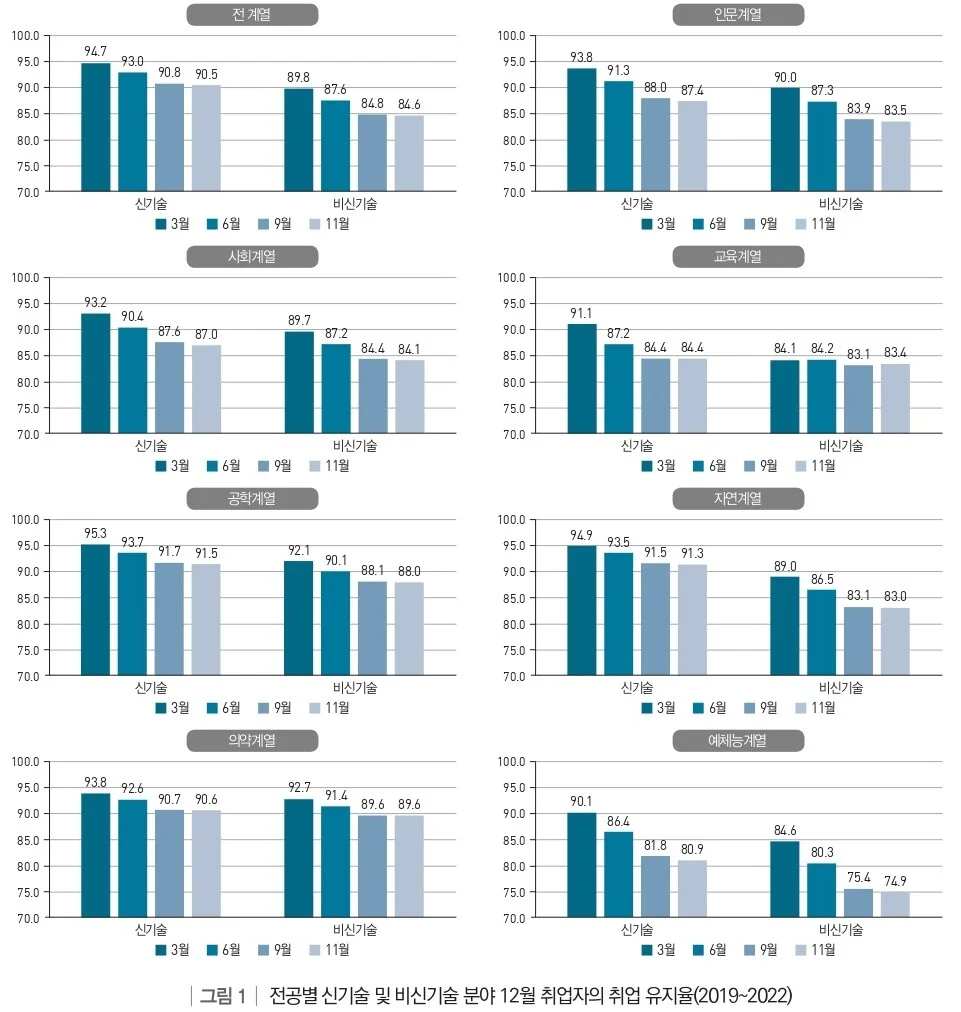
Research results show that high-tech sector jobs offer relatively greater stability. The Korea Research Institute for Vocational Education & Training (KRIVET) published KRIVET Issue Brief No. 300, analyzing employment retention rates among graduates who entered high-tech fields versus non-high-tech fields from 2019 to 2022 across 801,977 higher education graduates.
Key findings: High-tech sector employment retention rate: 90.5% vs. non-high-tech: 84.6% — a 5.9%p advantage, with high-tech consistently providing more stable jobs. The stability premium was most pronounced in natural sciences, arts/physical education, and humanities, as well as junior college graduates. By field: natural sciences 8.3%p (91.3% vs 83.0%); arts/PE 6.0%p (80.9% vs 74.9%); humanities 3.9%p (87.4% vs 83.5%). By education level: junior college 5.6%p most significant; universities 5.3%p; graduate schools 1.2%p (near-parity).
High-tech sector entry rates also increased steadily alongside the sector's rapid growth — rising from 18.4% (2019-2020) to 21.8% (2021-2022), a 3.4%p increase. Engineering majors led with 4.6%p increase (40.8%→45.4%), followed by natural sciences at 3.4%p (24.3%→27.7%). KRIVET researcher Hwang In-yeong noted: "Employment retention rates in high-tech fields exceeded non-high-tech across all majors and education levels — confirming a clear 'job stability premium' in high-tech sectors, reflecting the strong growth of the high-tech industry translating into labor demand."