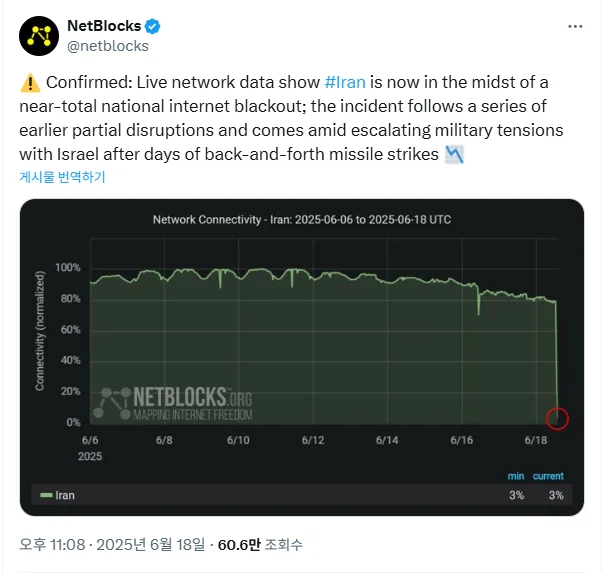
NetBlocks: "Temporarily Restored Then Blocked Again... Strategic Control to Protect Regime"
June 22, 2025: a nationwide internet shutdown in Iran that began June 18 is causing deep international concern. According to UK internet monitoring organization NetBlocks: Iran restricted internet access for approximately 62 hours; after connection was temporarily restored on Saturday the 21st, it was blocked again just 2 hours later. NetBlocks evaluated this as "effectively a nationwide digital blackout." The Iranian government explained this measure as a preemptive defensive action against Israeli-originated cyberattacks. However, international observers including NetBlocks assess the shutdown as strategic information control rather than defensive necessity: the timing (coinciding with domestic protests related to economic conditions) suggests the shutdown served to prevent protest coordination and documentation; the "restore then re-block" pattern indicates active decision-making about information flow rather than passive defense against attack. The Iran internet control architecture: Iran has been building the "National Intranet" (domestic internet infrastructure separated from the global internet) for over a decade; this architecture enables selective disconnection from the global internet while maintaining domestic services; the 62-hour shutdown demonstrated this capability is operational at national scale. The digital sovereignty question: Iran 62-hour shutdown represents one of the most complete applications of internet sovereignty doctrine since Russia partial shutdown during Ukraine invasion; the international human rights implications are significant -- internet access has been recognized by UN resolutions as essential for exercising fundamental rights.