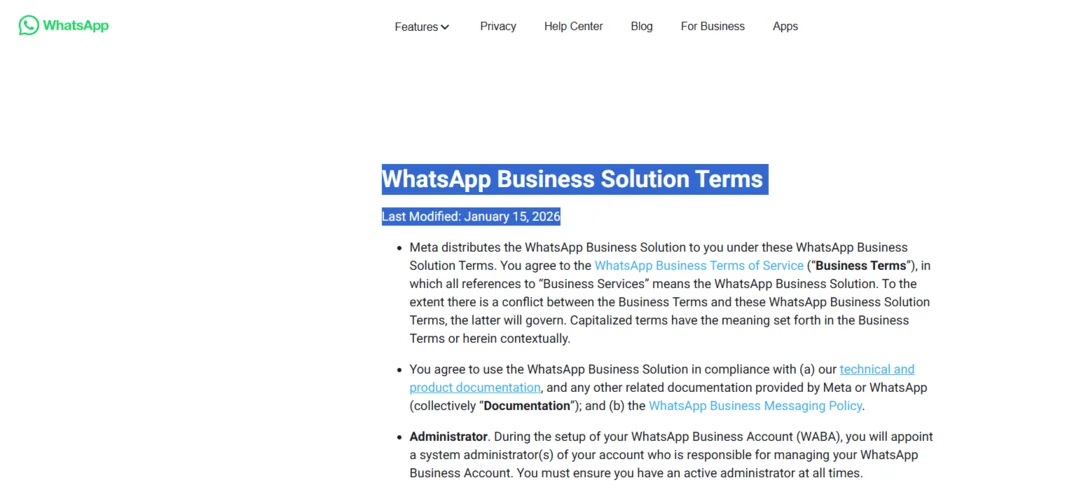
Meta's official WhatsApp Business Solution Terms showed "Last Modified: January 15, 2026" — with the current date being October 2025. The answer: Meta pre-published terms with a future effective date, not a future modification date. The official document contains: "These changes will go into effect on January 15, 2026, if you signed up before October 15, 2025." This is an effective date display, not a future error.
Meta's legal documents are managed through automated CMS with version control timestamps designed to display the "scheduled effective date" as "Last Modified." Structure: Document creation date: around October 2025; Scheduled effective date: January 15, 2026; Display format: Last Modified = effective date. This is automated display per internal version control logic, not human error.
The reason Meta uses this "future date display method" is to maintain global legal effectiveness consistency. WhatsApp is used in 180+ countries, with each country's privacy laws (GDPR, CCPA, PDPA, etc.) applied based on terms effective dates. Clearly distinguishing "Notice date" from "Effective date" and notifying users in advance is legally safer. This "advance time declaration" practice is standard for Google, Apple, Microsoft, and Amazon as well — displaying future effective dates in "Last Updated" as a legal buffer for advance notification to billions of users.
Nevertheless, from a user perspective, "a document with a future modification date" remains confusing. Transparency-wise, not specifying whether "Last Modified" is the actual modification date or effective date leaves room for legal interpretation confusion — particularly important for documents containing sensitive provisions on AI regulation or data use restrictions. The ideal approach would be separate "Effective Date" notation alongside "Last Modified." Terms are not future errors but "documents pre-announcing forthcoming effectiveness" — a result of complex legal and technical structures.